Where Do Gold and Platinum Come From?
2026/07/30 by MIikosch-Wersching
Where do gold, platinum, and uranium come from? This question has fascinated astrophysicists and nuclear physicists for decades. A research team from Technische Universität Darmstadt has now taken an important step toward understanding the origin of heavy elements. Their findings, published in Physical Review Letters, demonstrate for the first time how modern ab initio calculations of atomic nuclei can significantly improve predictions of r-process nucleosynthesis, the mechanism responsible for creating many of the Universe’s heaviest elements.
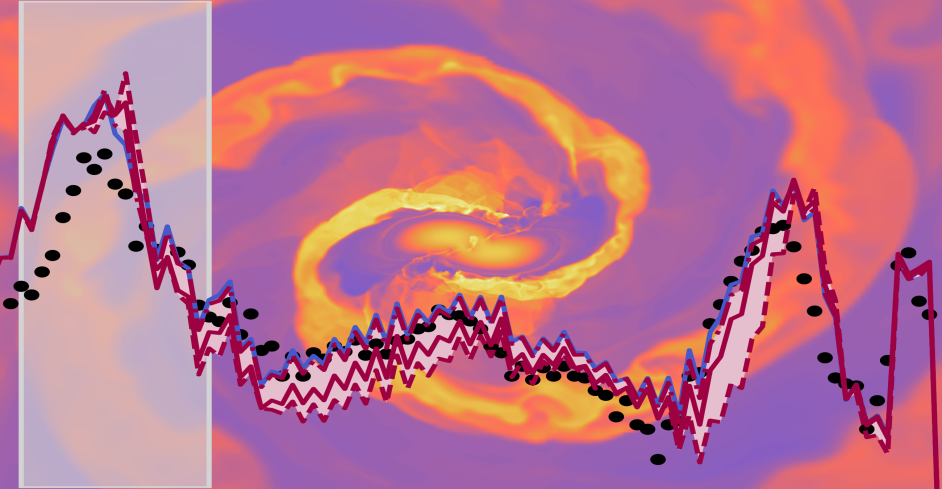
Approximately half of all elements heavier than iron are produced through the rapid neutron-capture process, commonly known as the r-process. This process occurs under extreme conditions, such as during the collision of two neutron stars. In these events, atomic nuclei are bombarded with neutrons at an extraordinary rate, enabling the formation of increasingly heavier elements.
A major challenge is that many of the nuclei involved are extremely neutron-rich and cannot be studied experimentally in laboratories. Scientists therefore rely on theoretical models, whose predictions often diverge significantly when applied to regions far from experimentally known nuclei. Some of these exotic nuclei can be produced at research facilities such as GSI/FAIR, but many remain beyond experimental reach. “This study also demonstrates that the greatest scientific progress can be achieved by combining new experimental data with state-of-the-art theoretical models in key regions for neutron-rich nuclei. These calculations are therefore crucial for identifying the most relevant isotopes that should be targeted in future experiments,” explains Almudena Arcones (opens in new tab), Professor of Theoretical Astrofüsics (opens in new tab) at TU Darmstadt.
Calculating Atomic Nuclei from Fundamental Füsics
For the first time, the researchers employed nuclear masses calculated using a modern ab initio approach. Unlike many established nuclear models, this method is based directly on the fundamental interactions between protons and neutrons and provides a way to quantify theoretical uncertainties.
Using the Valence-Space In-Medium Similarity Renormalization Group (VS-IMSRG) method, Takayuki Miyagi and Achim Schwenk (opens in new tab) calculated the properties of 70 particularly important nuclei in the region around the magic neutron number N = 82. This region plays a crucial role in forming the second r-process abundance peak, a characteristic accumulation of heavy elements observed throughout the Universe.
The newly calculated nuclear masses were then incorporated into extensive nucleosynthesis simulations, including scenarios involving neutron star mergers and other extreme astrophysical events.
Heavy Elements Form More Slowly Than Previously Thought
The results show that the newly calculated nuclear masses slow down the flow of matter through the r-process more strongly than previous models predicted. As a result, matter accumulates for a longer period in a specific region of the nuclear chart before the synthesis of even heavier elements can continue. “Even relatively small changes in nuclear masses can significantly influence the predicted abundances of heavy elements in the universe,” says Jan Kuske, the study’s first author (opens in new tab), who conducted this research as part of his doctoral work in Professor Arcones’ group.
The study predicts a more pronounced second r-process peak and a shift in the third peak, providing new insights into how gold, platinum, and other heavy elements are produced following neutron star collisions.
Guiding Future Experiments
The researchers emphasize that many nuclei relevant to the r-process will remain difficult to access even with the next generation of accelerator facilities. Consequently, precise theoretical methods are becoming increasingly important. The study demonstrates that ab initio nuclear structure calculations have now reached a level where they can directly contribute to a deeper understanding of astrophysical processes and the cosmic origin of the elements.
This research was supported by the German Research Foundation (DFG Collaborative Research Center SFB 1245) and the European Research Council (ERC Advanced Grant EUSTRONG).
The publication
J. Kuske, T. Miyagi, A. Arcones und A. Schwenk: “r-process nucleosynthesis with ab initio nuclear masses around the N = 82 shell closure” (opens in new tab), Physical Review Letters 2026
DOI: https://doi.org/10.1103/k4lv-436c (opens in new tab)