Securing Information in Fading Quantum Signals
2026/08/27
Imagine watching dozens of pendula swing in perfect synchrony. When they move together in a regular pattern, their collective motion is easy to follow and gives a clear signal for observing the oscillation. Over time, however, each pendulum drifts ever so slightly out of step. The collective motion appears to dissolve into disorder. Surprisingly, if you keep watching, the pattern eventually returns as the pendulums fall back into synchrony.
A remarkably similar phenomenon occurs in atom interferometers, one of the most promising technologies for future quantum sensors. Here, measurements rely on observing tiny changes in periodic quantum signals, which reveal small physical effects. As different parts of the quantum system gradually fall out of sync, the periodic interference signal fades before later reappearing. Until now, this temporary collapse of the signal has largely been regarded as a limitation for precision measurements.
Researchers at TU Darmstadt have now turned this apparent weakness into an advantage. Their work, published in Science Advances Volume 12 | Issue 35, shows that the collapse itself contains valuable information. Rather than discarding these fading measurements, the team developed a new analysis method that uses them to extract physical quantities more accurately and with reduced systematic bias.
„Parameter Estimation from Amplitude Collapse“ | PEAC
The new approach, called Parameter Estimation from Amplitude Collapse (PEAC), does not rely solely on the interference pattern. It makes additional use of how the signal strength changes as the quantum system dephases and later rephases, revealing information that conventional methods largely overlook.
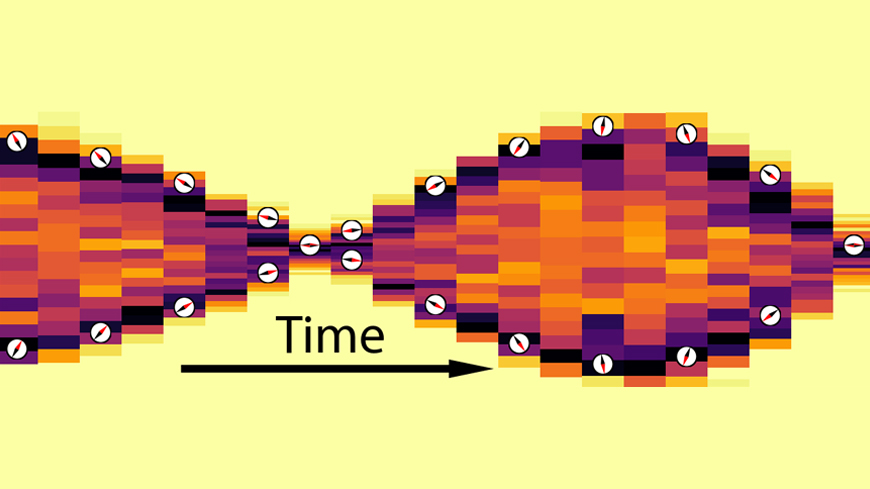
The accompanying illustration captures this process at a glance. At first, the measurements form two clearly separated bands, indicating a strong quantum signal. As the experiment progresses, the bands move closer together until they merge, as if the signal has almost disappeared. Later, they separate again as the signal returns.
This collapse and revival arises because the atoms are prepared in two different magnetic states. Since the two states respond slightly differently to a magnetic-field gradient, they gradually fall out of sync before naturally coming back into alignment. Alas, the quantum oscillations persist during all times and the signal only apparently disappears temporarily. The compass needles shown alongside the data provide a simple illustration of this changing relationship.
The work is the result of a close collaboration between experiment and theory at TU Darmstadt, bringing together researchers from the Atoms–Photons–Quanta group | Prof. G. Birkl and the Theoretical Quantum Optics group | Prof. E. Giese. By combining precision atom-interferometry experiments with new statistical methods, the team demonstrates that sometimes the most informative part of a quantum measurement is when the signal appears to disappear.
Atom interferometers are ultra-precise quantum sensors used for gravity, rotation, and tests of fundamental füsics. Comparing two such sensors cancels out noise, and any drift between them is actually the signal researchers want to measure. The catch is that as the two signals drift out of synch, the combined signal fades in and out, and this fading has usually been treated as a regime where little useful information remains. We show this fading period is actually rich in information: our new method, PEAC, extracts the measured quantity directly from how the signal fades and returns, with less systematic error than standard methods. It is especially useful where the signal nearly disappears, as often happens in tests of fundamental füsics.
The publication
D. Derr, D. Pfeiffer, L. Lind, G. Birkl und E. Giese: „Parameter estimation from amplitude collapse in correlated matter-wave interference“, Science Advances 12, eaeg5334 (2026),
DOI: doi.org/10.1126/sciadv.aeg5334 (opens in new tab)