How Moving Atoms Agree on a Common Direction of Light
2026/09/15
Research teams at the Institute for Applied Füsics at TU Darmstadt and the RPTU Kaiserslautern-Landau have demonstrated for the first time that, disordered atoms in permanent motion can nonetheless jointly emit directed light into a single direction despite neither the atoms nor their surrounding environment exhibiting a distinguishing directionality. Furthermore, the magnitude of this asymmetry can be controlled.

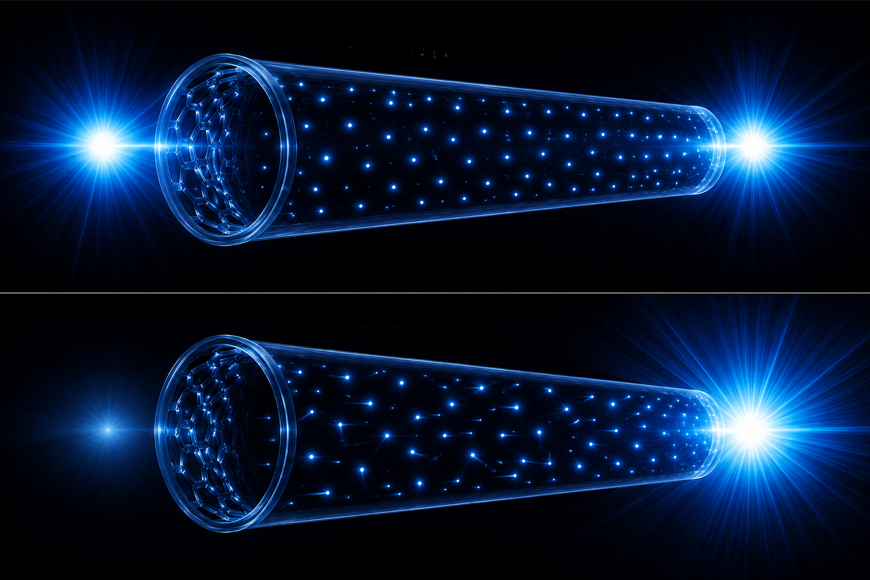
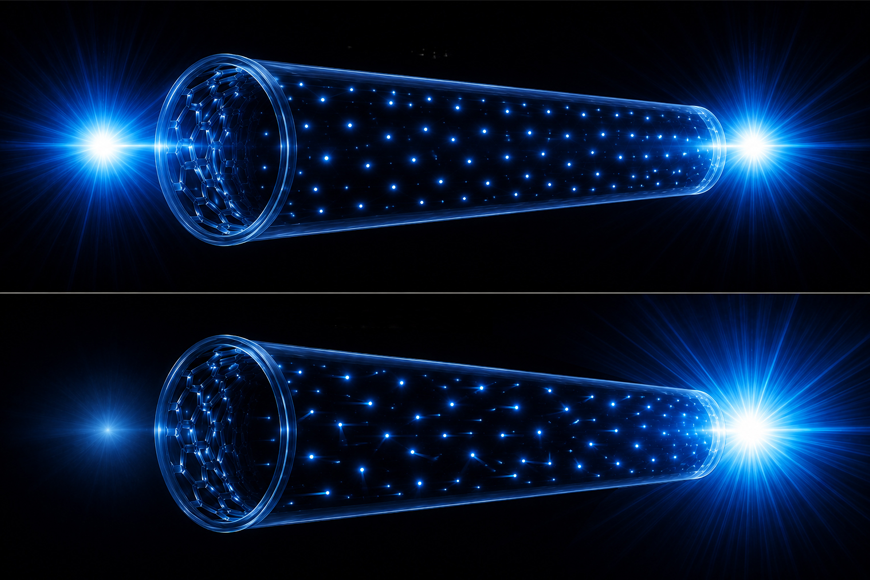
Normally, atoms emit light equally and independently from each other in all directions. As to emit light into a preferred direction, the atoms have to brought into an environment defining such a direction, or they have to communicate with each other. The latter can be achieved, e.g., by placing them very close to each other or coupling them by optical elements like mirrors or optical fibers. Despite the directional emission, this typically happens into opposite directions simultaneously. Directed light into a single direction could previously only be achieved when atoms sit in fixed, specially arranged structures which distinguish the two directions from the outset. The atoms in the Darmstadt team's experiment, by contrast, move freely and without order – yet still emit bundled, directed light. This is made possible by a hollow-core fiber connecting all the atoms: through this shared channel, the atoms coordinate and build up short, intensive light pulses propagating preferentially along the fiber.
What is new:
Until now, these pulses traveled equally in both directions along the fiber. The team shows – confirmed experimentally and through simulations at RPTU Kaiserslautern-Landau – that this balance can be deliberately tipped by tuning the speed of the atomic motion relative to the duration of emission. This directs more light toward the desired direction.
This work demonstrates that precise, designed structures and positioning of atoms is not a prerequisite for directional emission of light: also disordered atoms can collectively emit light into a single direction. The results open a new path to build directed light sources and optical devices.
The work has now been published in Physical Review Letters.
The publication
Yoan Spahn, Jens Hartmann, Benedikt Saalfrank, Michael Fleischhauer, Thomas Halfmann, and Thorsten Peters: „Motion-induced directionality of collective emission in a nonchiral waveguide“, Physical Review Letters
DOI: 10.1103/9dhz-dxc8