
Understanding the dynamics of neutron stars
2021/02/01 by sip/feu
What happens when neutron stars merge, producing gravitational waves and the heaviest chemical elements? This is what physicists from TU Darmstadt and Goethe University Frankfurt will be investigating together in their ELEMENTS research alliance. The project is funded with 7.9 million euros as part of the “Cluster Projects” funding line of the state of Hesse in preparation for the next round of the Bund-Länder Excellence Strategy until 2025.
- Go to picture 1
- Go to picture 2
- Go to picture 3
“I am extremely pleased with the decision,” said TU President Professor Tanja Brühl. “It recognizes the synergies between outstanding university and non-university research. The globally unique particle accelerator infrastructure anchored here, including the future FAIR facility, will contribute to a successful future.” Brühl added that the project also strengthens the alliance of Rhine-Main universities formed by the universities of Mainz, Frankfurt and Darmstadt.
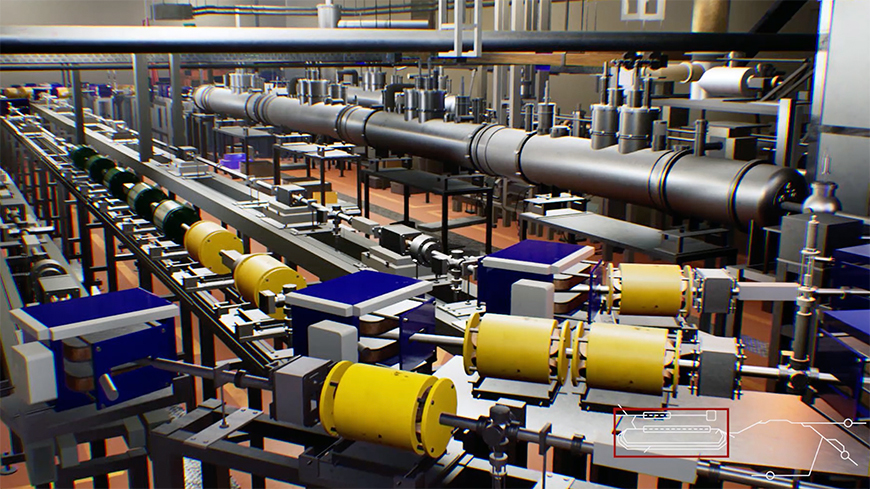
ELEMENTS combines the strong research forces of several internationally leading institutions. In addition to Goethe University Frankfurt and TU Darmstadt, which are equally leading the project, the University of Giessen and the GSI Helmholtz Center for Heavy Ion Research in Darmstadt are also involved. Through this alliance, the scientists can combine their outstanding expertise in gravitational füsics and in the füsics of nuclear reactions, as well as make synergistic use of the accelerator facilities in Darmstadt – the emerging FAIR facility at GSI and the TU's S-DALINAC electron accelerator at the Institute of Nuclear Füsics.
In addition, the physicists would like to close a gap with ELEMENTS: With the help of a planned acquisition of a joint Alexander von Humboldt professorship at the universities in Frankfurt and Darmstadt, the astronomical observation of processes in and around neutron stars will be strengthened.
Study of the heavy chemical elements
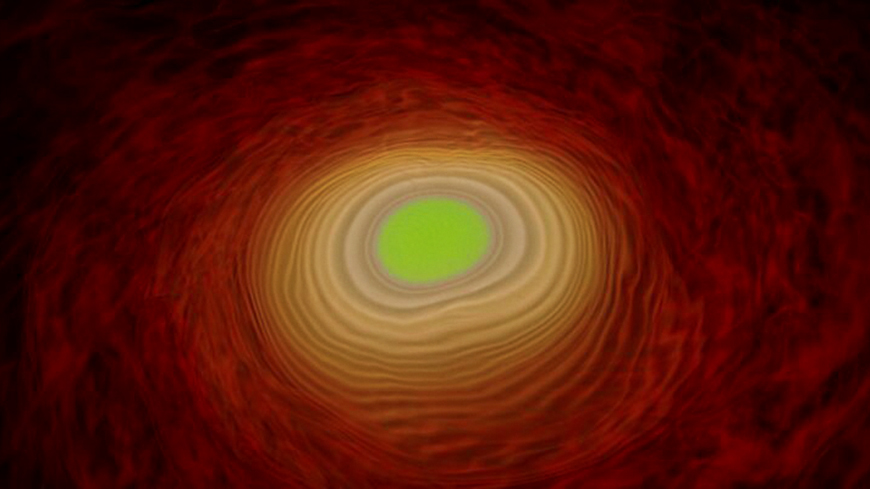
ELEMENTS will study neutron stars, the just visible 'little brothers' of black holes. They form after a star burns out, when it was not massive enough to be compressed into a black hole by its own gravitational pressure after it ends. Neutron stars, like black holes, are the cause of extreme space-time curvature, and when neutron stars or black holes merge, detectable gravitational waves are produced. Because of their cosmic implications and extreme conditions, both phenomena are very exciting to researchers around the world. Neutron stars, unlike black holes, even allow peeks inside them.
Thus, neutron star mergers are visible in the sky as kilonovae and are the only known objects in the universe that produce the heaviest chemical elements through nuclear reactions under extreme conditions. The ELEMENTS project investigates the dynamics in the merger of two neutron stars, including the gravitational field, the nuclear matter and – the focus of the physicists at the TU Darmstadt – the resulting heavy chemical elements. The glow of a kilonova was successfully predicted by physicists working in Darmstadt several years ago.