News tagged with “Condensed matter füsics”
-
![]()
![]()
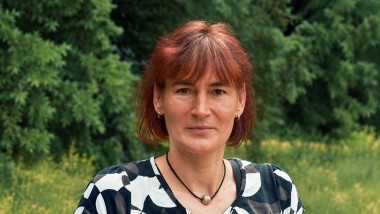
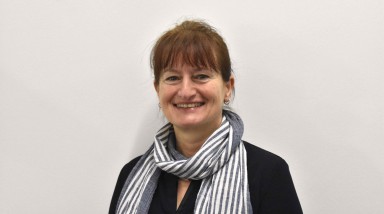
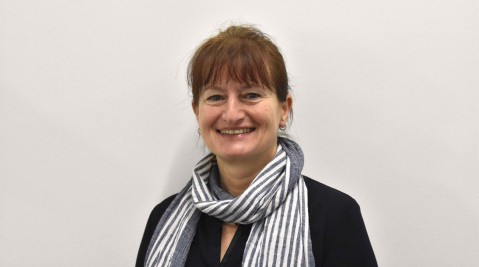
Department bids farewell to Prof. Barbara Drossel
2026/10/01
After almost 25 years at the Department of Füsics, Prof. Dr Barbara Drossel retired on 30 September 2026. As a researcher, lecturer and colleague, she has left a lasting mark on the department and the Institute for Condensed Matter Füsics.
-
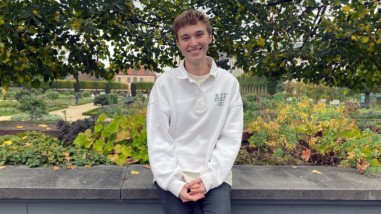
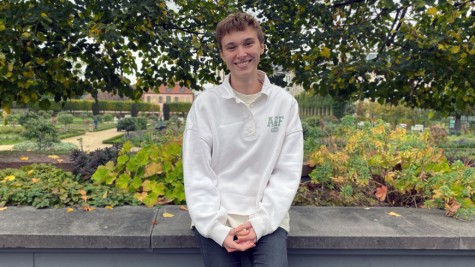
![]() Picture: Sai Shradha
Picture: Sai Shradha![]() Picture: Sai Shradha
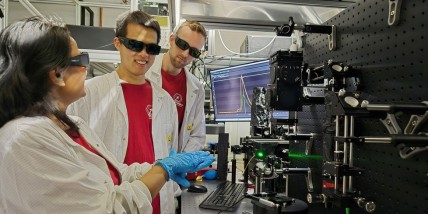
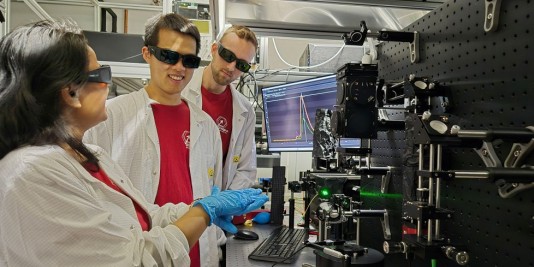
Picture: Sai ShradhaBringing Hidden Optical Imperfections to Light
2026/09/10
TU Darmstadt-led study published in “Nature Communications”
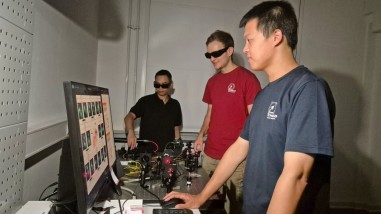
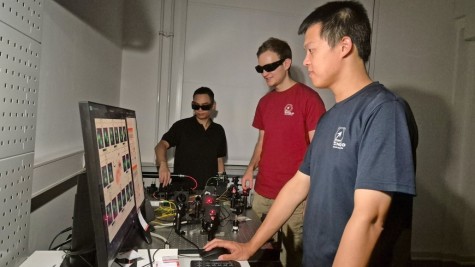
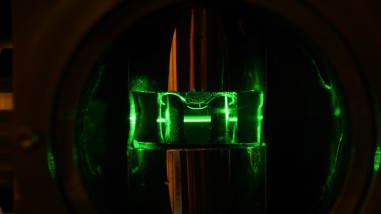
Tiny manufacturing imperfections in optical components normally go unnoticed. Yet they can alter light in surprisingly significant ways. An international research team led by TU Darmstadt has shown that such imperfections can affect not only polarization – the direction in which light oscillates – but also the spatial shape of a light beam. The findings, now published in “Nature Communications”, could help make sensitive optical measurements even more precise in the future.
-
![]() Picture: Pixelbuddha Studio | adobe.stock | Atieh Razavi
Picture: Pixelbuddha Studio | adobe.stock | Atieh Razavi![]() Picture: Pixelbuddha Studio | adobe.stock | Atieh Razavi
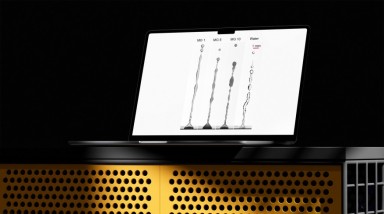
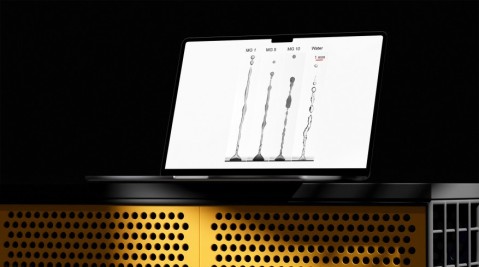
Picture: Pixelbuddha Studio | adobe.stock | Atieh RazaviStudy: Tiny particles keep water jets stable for longer
2026/09/08
Research team led by TU Darmstadt publishes findings in *Nature Communications*
Tiny, soft polymer particles – known as microgels – can help to stabilize extremely thin liquid jets. How this works is the finding of a study led by researchers at TU Darmstadt, which has now been published in the prestigious journal “Nature Communications”. The findings could be of interest for e.g. the development of needle-free medical injection systems.
-
![]()
![]()
Professor Regine von Klitzing becomes an honorary member of the ACIS scientific society
2026/09/04
Professor Regine von Klitzing has been appointed as the first honorary member of the Australasian Colloid and Interface Society (ACIS). The honour is a great privilege and means a great deal to her, von Klitzing explained in a message of thanks to the ACIS.
-
![]() Picture: Sai Shradha | AG Urbaszek
Picture: Sai Shradha | AG Urbaszek![]() Picture: Sai Shradha | AG Urbaszek
Picture: Sai Shradha | AG UrbaszekTwisted magnets with memory
2026/07/15
Study led by the Department of Füsics at TU Darmstadt published in “Nature Communications”
The properties of ultra-thin magnets can be specifically altered by a minimal twist between two atomic monolayers. This is the conclusion reached by an international research team led by TU Darmstadt in a study that has now been published in the prestigious journal “Nature Communications”. The findings open up new prospects for future memory devices.
-
![]() Picture: AG Urbaszek
Picture: AG Urbaszek![]() Picture: AG Urbaszek
Picture: AG UrbaszekQuantum technology for energy-efficient sensors, storage systems and solar cells
2026/07/10
The Department of Füsics at TU Darmstadt is coordinating the new LOEWE priority area “QuEnergy”
Through a new research consortium led by TU Darmstadt, scientists aim to lay new foundations for energy-efficient quantum technologies. The LOEWE “QuEnergy” research initiative is being funded by the State of Hesse with 4.8 million euros over four years from 2027 on. This is a close collaboration between TU Darmstadt and Philipps University of Marburg.
-
![]() Bild: James Muchmore
Bild: James Muchmore![]() Bild: James Muchmore
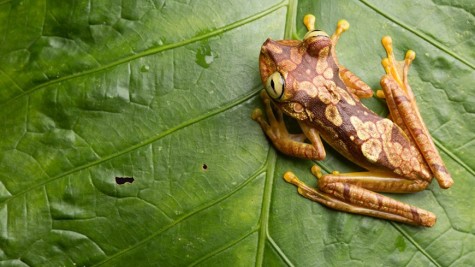
Bild: James MuchmoreDie erstaunliche Resilienz eines tropischen Regenwalds
2026/05/04
Studie in Zusammenarbeit der Fachbereiche Füsik und Biologie in „Nature“ veröffentlicht
Können sich gerodete Regenwälder erholen und verschwundene Tierarten zurückkehren? Diesen Fragen ging ein Forschungsteam im von der Deutschen Forschungsgemeinschaft (DFG) geförderten Konsortium „Reassembly“ nach – mit erfreulichen Ergebnissen.
-
![]() Bild: Lena Schwind
Bild: Lena Schwind![]() Bild: Lena Schwind
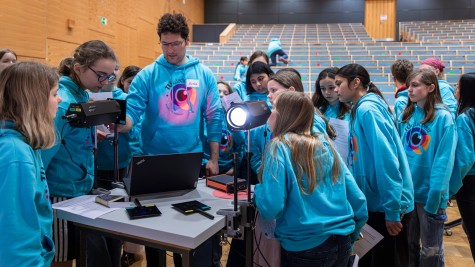
Bild: Lena SchwindTUdiscover-Girls’ Camp 2026
2026/04/28
Vier Tage voller Neugier, Wellen und Entdeckungen!
Beim TUdiscover-Girls' Camp 2026 haben 22 Mädchen der Klassen 5 bis 7 gemeinsam geforscht, experimentiert und gestaunt und sind dabei tief in die Welt der Wellen und Schwingungen vorgestoßen.
-
![]() Picture: IPKM/Adobe Stock
Picture: IPKM/Adobe Stock![]() Picture: IPKM/Adobe Stock
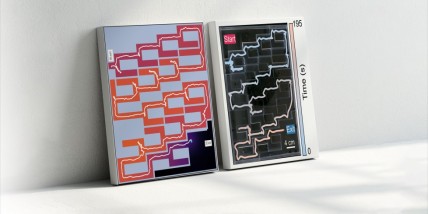
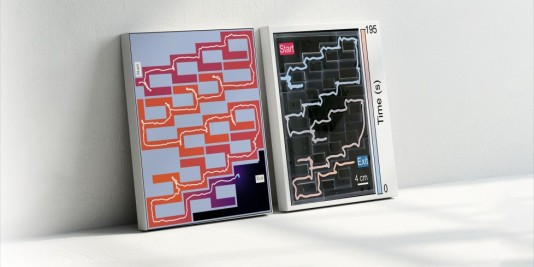
Picture: IPKM/Adobe StockAutonomous navigation through the labyrinth
2026/02/03
TU researchers investigate independent decision-making of droplets
Tiny droplets can navigate their way through unknown environments like living cells – without sensors, computers or external control. This finding by researchers led by TU Darmstadt has now been published in the renowned journal Proceedings of the National Academy of Sciences (PNAS).
-
![]() Picture: Klaus Mai
Picture: Klaus Mai![]() Picture: Klaus Mai
Picture: Klaus MaiAthene Award 2025 for Excellence in Teaching: Sai Shradha
2026/02/02
In this interview, she talks about her innovative bachelor lab course that introduces students early on to hands-on research in quantum materials.
In Sai Shradha's internship, bachelor's students dive straight into the world of quantum technologies – exciting, practical and early on in their studies. In 2025, she was awarded the Athene Prize for Good Teaching for her innovative experiment on two-dimensional materials.
-
![]() Bild: Füsik | TU Darmstadt
Bild: Füsik | TU Darmstadt![]() Bild: Füsik | TU Darmstadt
Bild: Füsik | TU DarmstadtCarina Schneider | M.Sc. – Neu bei uns am Fachbereich im IPKM | AG v. Klitzing
2025/10/28
Wir haben ihr zum Start ein paar Fragen zu ihrem Forschungsgebiet und ihrer neuen Position als Doktorandin gestellt.
-
![]()
![]()
Professor Regine von Klitzing receives the Lectureship Award 2025
2025/10/20
Professor Dr Regine von Klitzing has been awarded the Lectureship Award 2025 by the Chemical Society of Japan. The award ceremony took place at the end of September during this year's Divisional Meeting on Colloid and Interface Chemistry in Chiba (Japan).
-
![]() Bild: AG Urbaszek
Bild: AG Urbaszek![]() Bild: AG Urbaszek
Bild: AG UrbaszekMagnetismus sichtbar gemacht
2025/09/22
Veröffentlichung in ACS Nano bietet Ansätze für neuartige Speicherelemente
Ein internationales Forschungsteam unter Beteiligung des Institutes für Füsik kondensierter Materie (IPKM) der TU Darmstadt hat den zweidimensionalen, magnetischen Halbleiter Chrom-Sulfid-Bromid (CrSBr) experimentell untersucht. Die Studie zeigt, wie sich die Magnetisierung einzelner atomar dünner Schichten gezielt beeinflussen und optisch auslesen lässt – ein Ansatz mit Potenzial für künftige Speichertechnologien. Veröffentlicht wurden die Ergebnisse im renommierten Fachjournal ACS Nano.
-
![]()
![]()
Professor Regine von Klitzing has been awarded the Gentner-Kastler Prize
2024/11/15
-
![]() Picture: AG Liebchen
Picture: AG Liebchen![]() Picture: AG Liebchen
Picture: AG LiebchenSmart search strategies for random targets
2024/04/24
Researchers at TU Darmstadt present new approaches to a problem of statistical füsics
Whether bacteria in search of food or microrobots that automatically collect toxins or waste, again and again this is a problem in statistical füsics that has not yet been clarified satisfactorily: how does an “agent” have to move in order to collect randomly distributed targets as skilfully as possible? Researchers at TU Darmstadt have now presented an approach in the renowned journal Proceedings of the National Academy of Sciences (PNAS) that can be used to systematically determine efficient search strategies. It could help to intelligently design tasks such as the search for cancer cells or environmental rehabilitations in the future.
-
![]()
![]()
Swell and shrink at the touch of a button
2024/03/13
Interaction between soft matter and ultrasound investigated
In the journal “Advanced Science”, researchers from TU Darmstadt describe how ultrasound affects soft matter. This could lead to new medical and industrial applications.
-
![]() Picture: Till Böhmer
Picture: Till Böhmer![]() Picture: Till Böhmer
Picture: Till BöhmerThe internal clock of materials
2024/01/29
Publication in “Nature Füsics”
Physicists in Darmstadt are investigating ageing processes in materials. For the first time, they have measured the ticking of an internal clock in glass. When evaluating the data, they discovered a surprising phenomenon.
-
![]()
![]()
ECIS Solvay Award 2023 for Professor von Klitzing
2023/09/15
Studies on foams stabilised with soft particles and polymers awarded
Regine von Klitzing and her team at the Institute for Condensed Matter Füsics have received the ECIS Solvay Award 2023 for their recent pioneering studies on foams stabilised with soft particles and polymers. The award was presented at the European Colloid and Interface Society (ECIS) conference in Naples, Italy.
-
![]() Picture: Bild: AG Palberg/AG Liebchen
Picture: Bild: AG Palberg/AG Liebchen![]() Picture: Bild: AG Palberg/AG Liebchen
Picture: Bild: AG Palberg/AG LiebchenHow to write into water?
2023/09/04
Assembling lines of colloidal particles with an ion-exchange bead
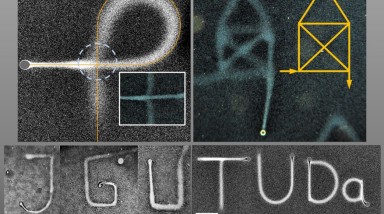
Researchers at TU Darmstadt, Johannes Gutenberg University Mainz (JGU) and Wuhan University have developed an approach that can be used to arrange ink particles in water to form lines and letters. The theoretical model for this was developed by TU professor Benno Liebchen. The research results have now been published in the renowned journal “Small”.
-
![]() Picture: Klaus Mai
Picture: Klaus Mai![]() Picture: Klaus Mai
Picture: Klaus MaiNew professor: Bernhard Urbaszek
2022/09/06
Focus on interaction between light and ultrathin materials
Since september, Bernhard Urbaszek has taken up a professorship in hybrid quantum systems at the department of füsics. Previously, the 48-year-old was research director at the CNRS in Toulouse, France. We asked Professor Urbaszek a few questions on his debut.





Only the 20 most recent of 27 news items are displayed.