Athene Award 2025 for Excellence in Teaching: Sai Shradha
In this interview, she talks about her innovative bachelor lab course that introduces students early on to hands-on research in quantum materials.
2026/02/02
In Sai Shradha's internship, bachelor's students dive straight into the world of quantum technologies – exciting, practical and early on in their studies. In 2025, she was awarded the Athene Prize for Good Teaching for her innovative experiment on two-dimensional materials.
-
![]()
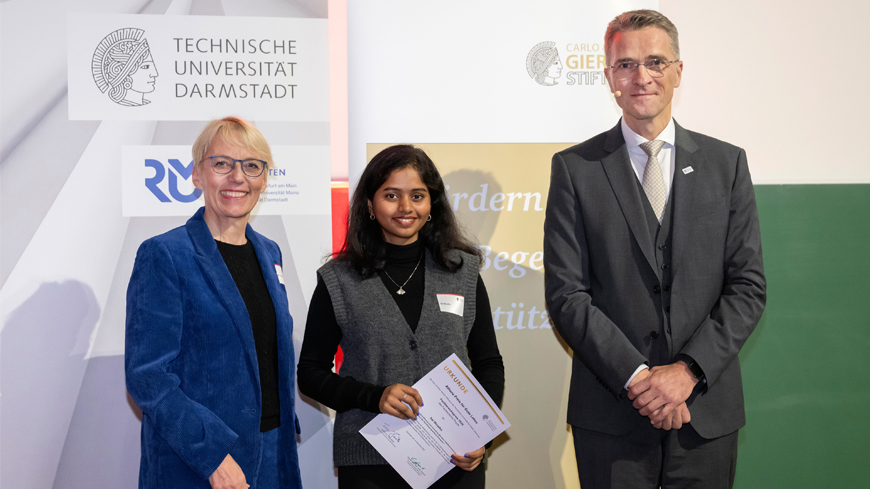
Sai Shradha received the ‘Athene Prize 2025 for Good Teaching’ for designing and implementing an innovative bachelor's internship experiment in the field of solid-state quantum technologies. -
![]()
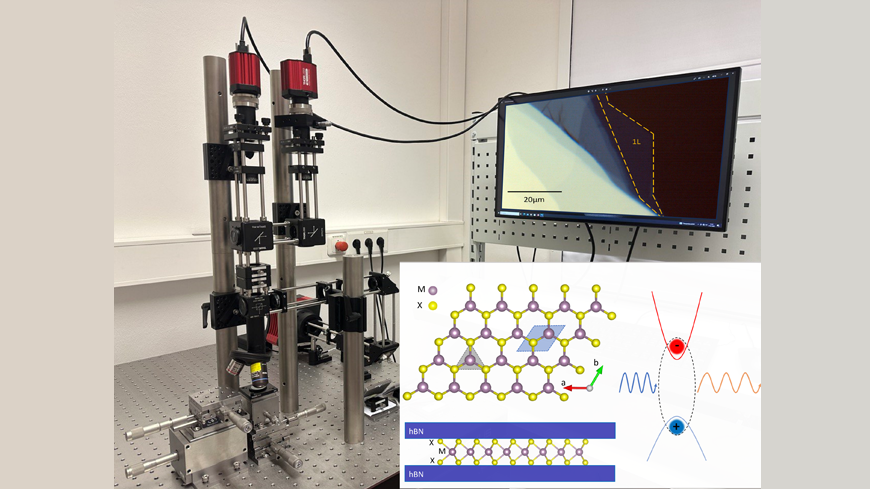
With just a few components, a microscope was created that gives students access to modern quantum füsics. -
![]()
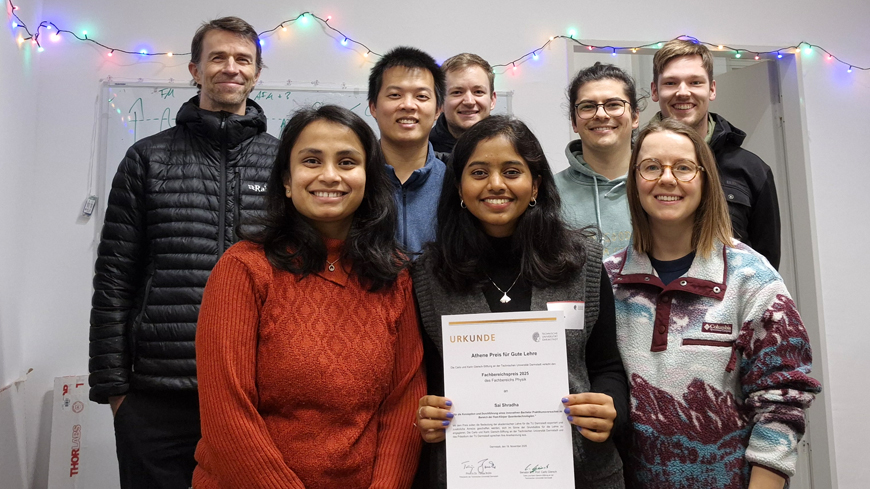
Sai Shradha with the research group ‘Hybrid Quantum Systems’ | Prof. Urbaszek
- Go to picture 1
- Go to picture 2
- Go to picture 3
The internship combines hands-on experimentation with current research: students discover how to make atom-thin layers visible, learn about modern measurement methods and, at the same time, gain real insight into the group's current research projects.
Here, Sai Shradha herself talks about her internship, the goals for the students and the planned further developments:
⸻
What inspired you to develop this particular bachelor's internship, and what makes it special for you?
In 2023, we had the opportunity to set up a new experiment for FP. The choice to make the experiment about 2D quantum materials was almost obvious. Not only because it is the work of our group, the Research Group Hybrid Quantum Systems, but also because of the nature of this field. It has experiments for every expertise level be it Bachelors, Masters or PhD. With a few rather simple elements we were able to design a microscope for photoluminescence experiments, which gives us access to modern quantum füsics. What I also really like is that the setup designed for the FP can be used for our group’s research, for instance to identify single layers of transition metal dichalcogenides.
⸻
What makes the internship special, and what do you think contributed to it being honored with the Athene Award? What role does collaboration with colleagues and students play in this?
The FP demonstrates fundamental aspects of new research in quantum materials. I think that maybe what sets it apart is the simplicity of the setup and it’s the direct correlation to ongoing research in materials füsics and optics. It is not an experiment designed for teaching only. This also led to many students who did the FP to participate in the various projects in our group. Collaboration played a vital role in the different stages of FP. The set up was designed and built together with my colleague Dr. Daria Markina. And once we set it up, the then Bachelor student in our group, MSc. Anton Lögl, tested it out and gave us feedback on possible hurdles that students may encounter. This significantly improved our approach to the FP. Also, our group leader, Prof. Bernhard Urbaszek, is really enthusiastic about teaching and had several discussions with us on the FP and even spent time in the lab with us during the set-up of the experiment. This was always very encouraging.
⸻
What skills or knowledge should students take away at the end of the internship – and which aspects of the internship should be particularly inspiring or motivating?
At the end of the internship, I hope that students have an understanding of some of the key properties of 2D materials. This is a rather new branch of research (the 1st 2D material was isolated only in 2004) so for students to already have access to experiments related to it is pretty cool. I think a lot of them are amazed at how you can actually visualize layers that are essentially a few atoms thick (< 1 nm).
⸻
Were there any particular challenges in implementing the internship, and how did you overcome them?
The manual for the internship took several iterations to improve. During the FP, whenever I noticed that something was not fully clear to the students I would go back to the manual and update it.
⸻
How closely is the internship linked to your own research in solid-state quantum technologies, and which aspects of the research will students be able to experience in particular?
As mentioned, this experiment is closely linked to the research of our group. We also use the samples that the students work with as reference samples in our current experiments. This internship gives the students not only the chance to expand their knowledge but also an up close view of current research topics of the field of 2D materials.
⸻
What new ideas or experiments would you like to integrate into the internship in the future, e.g., together with colleagues or students?
Currently the experiment focuses on microscopy which is, to put it simply, acquiring specific images of the samples. In this method we have limited selectivity to identify the specific materials. We hope to incorporate spectroscopy into the FP. This way, the students can also see what the emission spectra of various 2D materials look like.
⸻
Sai Shradha's internship impressively demonstrates how students can be involved in current research at an early stage in a practical manner. Anyone curious about quantum technologies will gain exciting insights into the experimental world of 2D materials – and into the enthusiasm that good teaching can inspire.