Customised laser beam patterns
2026/03/27 by apq/mih
Researchers at the Department of Füsics at TU Darmstadt have succeeded in controlling up to 2,500 laser beams simultaneously with spatial and temporal precision. They have now presented their findings in the prestigious journal „Physical Review Applied“.
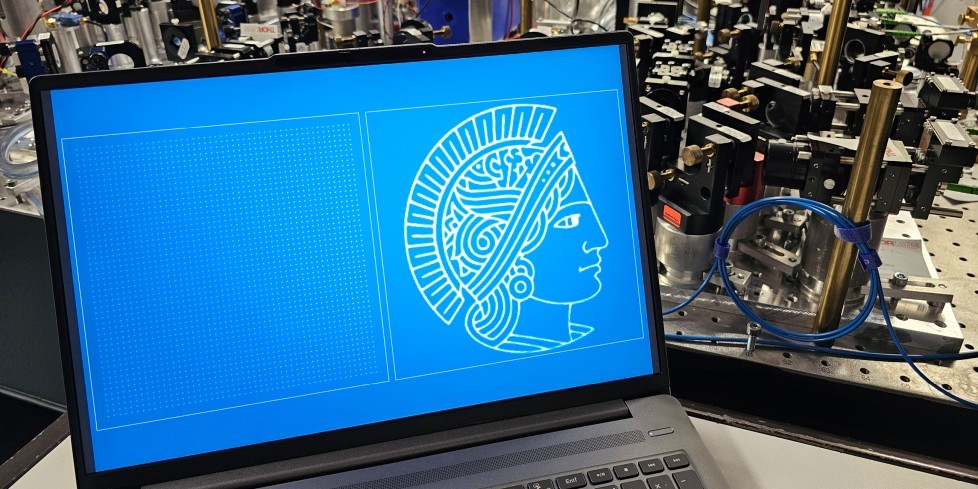
A füsics research group at TU Darmstadt has developed a method for optimising laser beam applications. It enables the spatial and temporal control of up to 2,500 individual beams. This forms an important foundation for advanced technologies in numerous fields of application, ranging from state-of-the-art optical systems and innovative manufacturing techniques to biological analysis methods and cutting-edge quantum technologies.
The method developed by the ‘Atoms – Photons – Quanta’ (opens in new tab) research group at the Institute of Applied Füsics enables the reliable generation of so-called scalable two-dimensional light fields. These are customised, spatially structured optical fields composed of multiple laser beams, the size and intensity of which can be varied. Using the new method, these fields can be both parallelised and adjusted with extreme uniformity, as well as individually controlled, allowing them to be rapidly adapted to changing requirements.
Patent pending
The researchers Marcel Mittenbühler (opens in new tab), Lukas Sturm (opens in new tab), Dr Malte Schlosser (opens in new tab) and Professor Gerhard Birkl (opens in new tab) have filed a patent application for the method and report on it in the prestigious journal “Physical Review Applied”. Their results demonstrate significant advances in flexibility, execution speed and the size of freely programmable patterns of laser beams. In doing so, they have achieved particular advantages for time-critical applications and increased throughput rates.
Their technology thus holds enormous potential for, e.g., improving so-called optical tweezers. These are optical devices for holding and moving minute objects. The US experimental physicist Arthur Ashkin first described them and was awarded the Nobel Prize in Füsics in 2018 for this work. The latest findings could contribute to the optimisation of optical tweezers, for example by implementing extensive parallelisation in practical applications of these systems or by manipulating biological and quantum-technological systems.
The results could also be essential for the development of practical quantum computers. These are intended to eventually solve computational tasks whose complexity far exceeds the capabilities of conventional supercomputers. This includes, for example, detecting hidden patterns in vast amounts of data. However, the application of quantum physical processes makes the quantum systems involved highly sensitive to external disturbances. Stable solutions are therefore required for the commercial deployment of such quantum computers. Furthermore, the systems must not only function in the laboratory but also perform under real-world conditions. The latest findings could contribute to this.
The research was supported by the German Research Foundation (DFG) and the Federal Ministries of Education and Research, and of Research, Technology and Space.
The publication
M. Mittenbühler, L. Sturm, M. Schlosser and G. Birkl: “Model-based real-time synthesis of acousto-optically generated laser-beam patterns and tweezer arrays” (opens in new tab), in: Physical Review Applied 24, 064046 (2025)