Study: Tiny particles keep water jets stable for longer
2026/09/08 by IPKM/mih
Tiny, soft polymer particles – known as microgels – can help to stabilize extremely thin liquid jets. How this works is the finding of a study led by researchers at TU Darmstadt, which has now been published in the prestigious journal “Nature Communications”. The findings could be of interest for e.g. the development of needle-free medical injection systems.
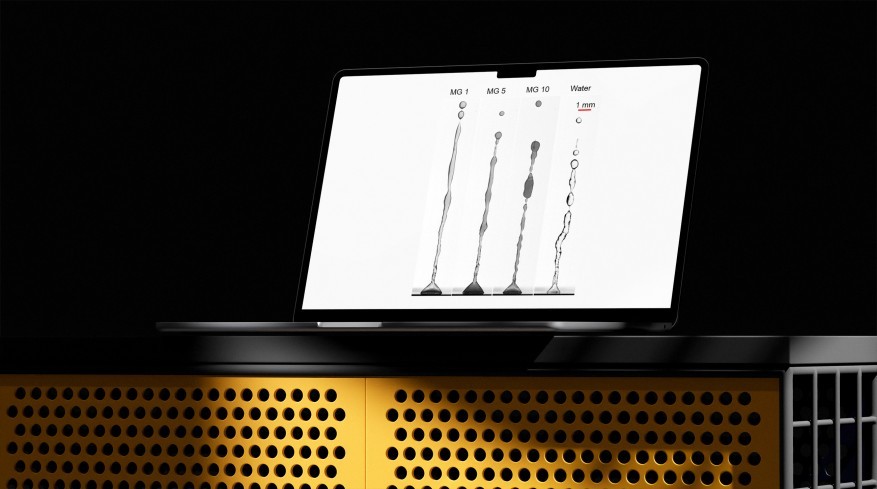
Microgels are soft polymer particles less than one micrometre in size. They can adsorb at the interface between air and water, where they reduce the surface tension of the liquid. In this respect, their effect is similar to that of conventional surface-active components – so-called surfactants – such as those often found in soap, washing-up liquid or detergent. However, unlike many conventional surfactants, the microgels used in the study are non-toxic and their interaction mechanism with the liquid differs significantly.
For their experiments, the scientists generated extremely thin jets of water using surface acoustic waves. A drop of water containing the microgels was used for this purpose. A special manufactured chip generated the waves with a frequency of around 64 MHz, which produced a liquid jet of approximately 200 micrometres diameter out of the drop. A high-speed camera recorded the jet formation and extension.
“This revealed a surprising effect: although the microgels themselves are only around 700 nanometres in size, their properties can determine the stability of a liquid jet extending over a centimetre,” explains Dr. Amin Rahimzadeh from the Institute of Condensed Matter Füsics (opens in new tab) at the Department of Füsics, TU Darmstadt. “The softer the particles were, the longer the water jet remained stable.”
Particle stiffness as a key factor
The decisive factor appears to be the extent to which the microgels can deform. The researchers tailored the stiffness of the particles during their synthesis by modifying the cross-linking of the so-called polymer scaffold, i.e. the three-dimensional, porous structure, the polymer forms. A more cross-linked framework makes the microgels stiffer, whilst weaker cross-linking makes them softer.
Computer simulations provided an explanation for the observation: “at the interface between air and water, soft microgels can stretch and deform more readily. In doing so, they remain connected to one another, thereby ensuring that the surface tension remains low. Stiffer particles, by contrast, detach from one another more easily. This causes the liquid jet to become unstable and break up sooner” explains Dr. Suvendu Mandal from the Institute of Condensed Matter Füsics (opens in new tab) at the Department of Füsics, TU Darmstadt.
Potential for reducing medical waste
The researchers see potential applications particularly in so-called needle-free drug delivery. This involves using very thin and fast liquid jets to deliver drugs through the skin without a conventional needle. According to the team, better control of jet stability could help make such systems more reliable. In the long term, this could reduce the need for invasive injections and medical waste from disposable needles.
The findings could also be significant for inkjet printing. According to the researchers, the investigation of microgels under the extremely rapid and severe deformations that occur during jet formation is particularly novel. They explained that the relationship between the behaviour of individual microgels at the interface and the stability of a significantly larger liquid jet had been investigated for the first time.
The first author, Atieh Razavi, explained that observing this process requires specialized equipment because the event occurs far beyond human perception: “This jetting process is so fast, one cannot observe it by the naked eye and needs a high-speed camera with a resolution of less than a millisecond.”
Dr. Andreas Winkler and Dr. Mehrzad Roudini from Leibniz Institute for Solid State and Materials Research in Dresden (opens in new tab), that designed the acoustic setup for the experiments, described the observed effect as highly exciting and emphasized its potential for improving future technologies. They are particularly interested in optimizing the acoustic wave transducers and electric signaling – the components responsible for generating and controlling the liquid jets – to enable more precise and controlled drug delivery systems and droplet-on-demand sources.
Professor Regine von Klitzing highlighted the significance of seeing microgels move from fundamental research toward practical applications. Previous studies of microgels have largely focused on understanding the behaviour of individual particles or groups of particles under controlled conditions, she said. The new research demonstrates how this knowledge can contribute to real-world technologies.
Professor Benno Liebchen from the Institute of Condensed Matter Füsics at the Department of Füsics, TU Darmstadt, also highlighted the importance of theoretical modelling in understanding the complex phenomenon: “The simulations reveal a mechanism by which nanoscale interactions create a safety net that protects soft interfaces against breakup – even in a centimeter-long jet.”
The publication
Razavi, A., Roudini, M., Winkler, A., Liebchen, B., v. Klitzing, R., Mandal, S. und Rahimzadeh, A.: “Soft microgel networks stabilize and extend nozzle-free water jets”. In: “Nature Communications” 17, 8819 (2026). doi.org/10.1038/s41467-026-76854-0 (opens in new tab)