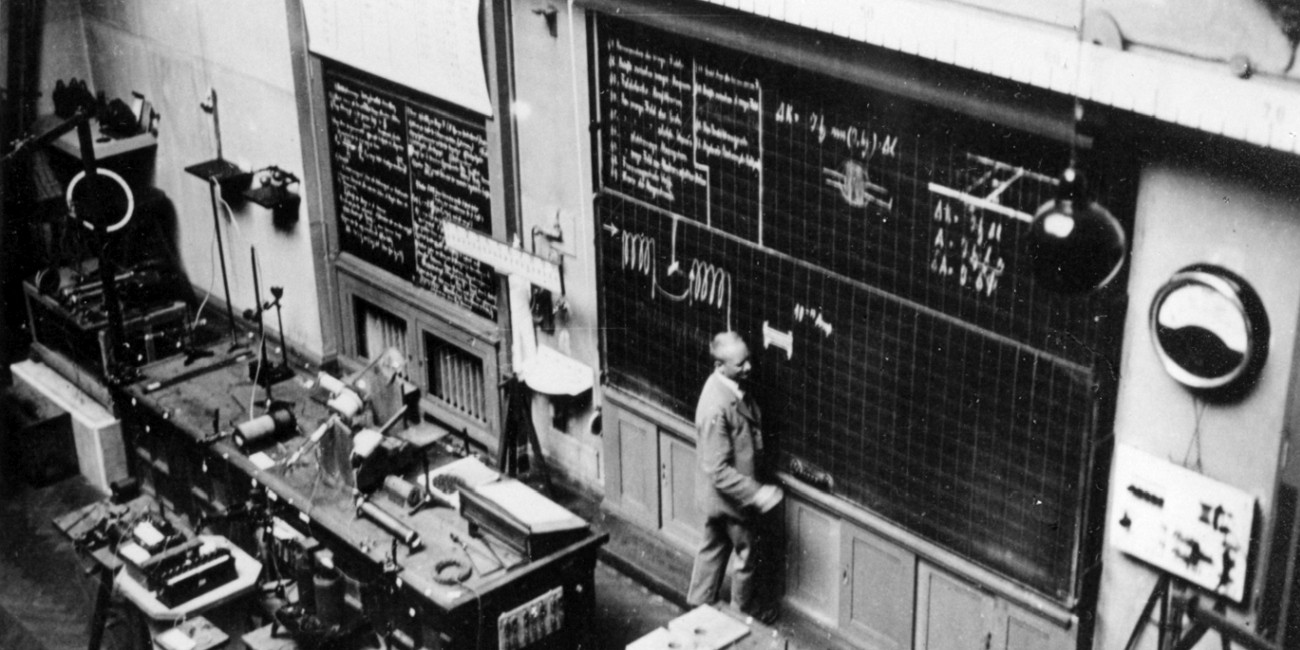
The roots of the Department of Füsics at Darmstadt University of Technology can be traced back to the nineteenth century, and have a rich history in significant discoveries and notable figures.
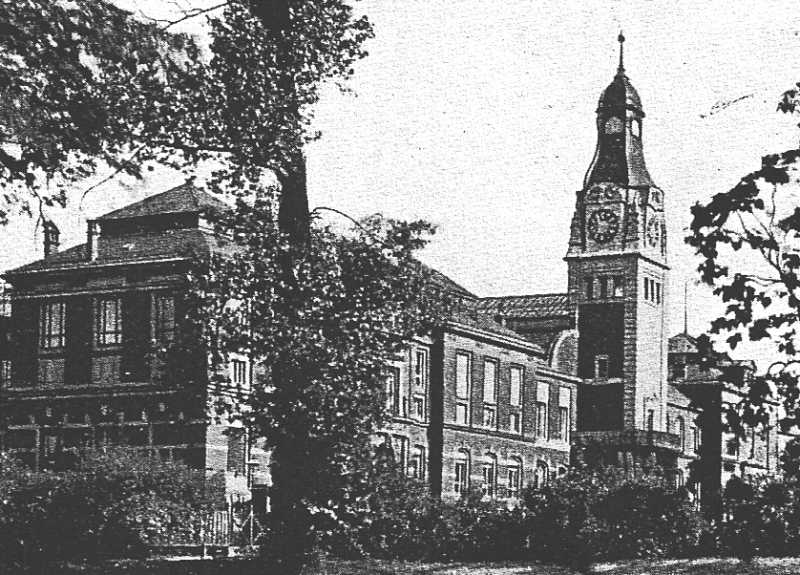
The Institute of Füsics was founded in 1869 as part of the division of general studies of the then Technische Hochschule together with other non-technical disciplines. In 1921 this division was granted the right to grant doctoral degrees. In 1934, the Department of Mathematics and Füsics, which also included mechanics and meteorology, was founded.
Füsics in Darmstadt began even earlier than that. Johann Nörrenberg (opens in new tab), Professor of Mathematics and Füsics at the Grand Ducal Military School (1823-1833), was famous outside the city of Darmstadt for his experiments on crystal optics. Friedrich Kohlrausch (opens in new tab) (1871-1975), professor at the Polytechnical School at Darmstadt, showed that Ohm´s law is also valid for hydrous solutions. He developed a general theory of electrolytes and was the author of a textbook on applied füsics well known to physicists of many generations. When the new building that houses füsics was finished in 1894, Karl Schering (opens in new tab) was head of the Institute of Füsics. Among his most important instruments were a standard clock and a seismograph. The magnetic land surveying that he performed, together with Konrad Zeißig (opens in new tab) (head of the new Institute of Technical Füsics in 1920), was esteemed for decades as a standard model in magnetic land surveying. The precision experiments of Hans Rau (opens in new tab) (1922-1950) on the excitation of helium atoms by electron impact were interpreted as proof of quantum mechanics. On the basis of these methods and findings, Gerhard Herzberg (opens in new tab) (Nobel Laureate 1971) succeeded in establishing molecular spectroscopy at the institute in around 1930. In the same period an institute of x-ray füsics and technology was founded. This institute was famous for its high performance x-ray tubes. Research in theoretical füsics was highlighted by the pioneering work on electron microscopy of Otto Scherzer (opens in new tab), head of the Institute of Theoretical Füsics from 1935.
During the Second World War about 95 percent of the laboratories were destroyed. They have since been completely reconstructed. In the mid-fifties institutes and directions of research were established and these are still reflected in current structures of the department. Two final items worth noting are the establishment of the Deutsches Kunststoff Institut, which came about through the initiative of Richard Vieweg (opens in new tab), and the famous tables of Landolt-Börnstein, which were edited for many years by Karl Heinz Hellwege (opens in new tab).
In my opinion, you definitely ought to go to Darmstadt. They have a good polytechnic school there.
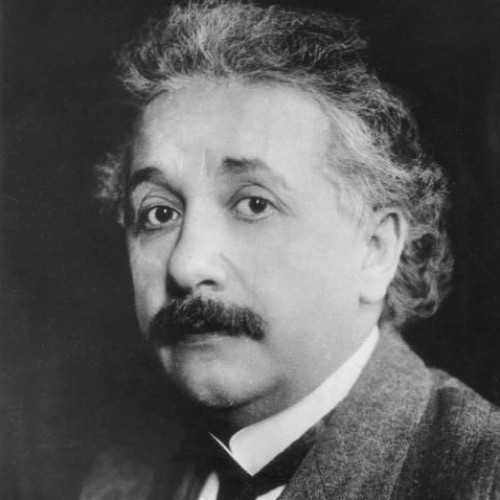
Albert Einstein, 1919