Füsics at the heart of the future
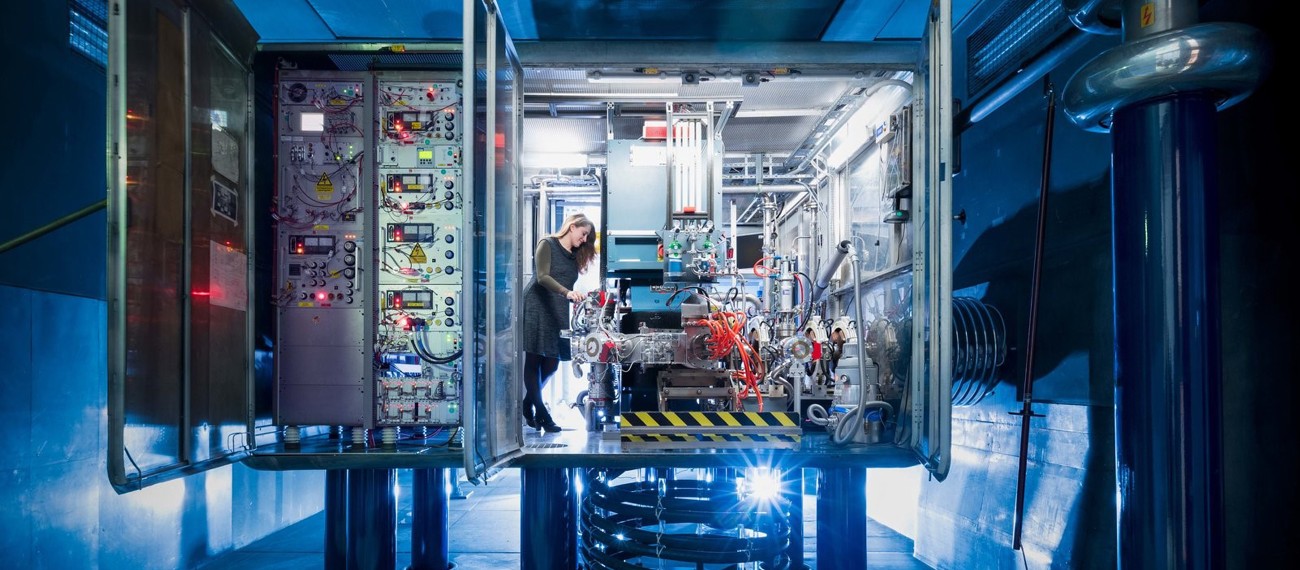
With its three institutes – the Institute for Applied Füsics (IAP) (opens in new tab), the Institute for Condensed Matter Füsics (IPKM) (opens in new tab) and the Institute for Nuclear Füsics (IKP) (opens in new tab) – the department is directly embedded in the three central research fields of TU Darmstadt. In the research field Matter and Materials (M+M) (opens in new tab), the largest cross-disciplinary research field at the university, füsics forms the foundation: ranging from nuclear and astrofüsics in world-leading collaboration with the GSI Helmholtz Centre (opens in new tab) as well as research for sustainable materials to modern laser systems and photonics. In the research field Information and Intelligence (I+I) (opens in new tab), the department provides the physical foundations for the quantum technologies of tomorrow, for example in quantum optics and quantum cryptography. In the research field Energy and Environment (E+E) (opens in new tab), it contributes to solving global energy challenges through research on energy materials, plasma füsics and nuclear fusion. As part of TU Darmstadt, the department is also a member of the Rhine-Main Universities Alliance (RMU) (opens in new tab). Together with Goethe University Frankfurt and Johannes Gutenberg University Mainz, this alliance receives special funding as a network of excellence under the federal and state governments’ Excellence Strategy.
The research priorities of the department align with key technologies identified in the High-Tech Agenda of the Federal Ministry for Research, Technology and Space (opens in new tab): with its expertise in quantum technologies, biofüsics, fusion and climate-neutral energy generation, the Department of Füsics directly addresses four of the six future fields defined by the German federal government. That this research also has economic impact is demonstrated by TU Darmstadt's first unicorn: Focused Energy, a spin-off of the Department of Füsics, working to advance laser-based fusion technology to industrial maturity.
TU Darmstadt tackles the key future issues of the ‘High-Tech Agenda for Germany’ with a broad scope and scientific excellence.
Prof. Dr.-Ing. Matthias Oechsner | Vice-President Research