-
![]() Picture: akromin/TU Darmstadt
Picture: akromin/TU Darmstadt![]() Picture: akromin/TU Darmstadt
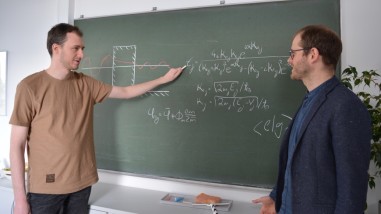
Picture: akromin/TU DarmstadtUnderstanding the interior of atomic nuclei
2024/07/01
Publication by TU researchers in the renowned journal “Physical Review Letters”
Atomic nuclei can be tiny magnets. Their magnetic moment can be precisely measured, but the corresponding calculations have been deficient until now. Physicists from TU Darmstadt have now solved this problem, as they report in the journal “Physical Review Letters”.
-
![]() Picture: Christian Karres
Picture: Christian Karres![]() Picture: Christian Karres
Picture: Christian KarresWhat is “time” for quantum particles?
2024/05/16
Publication by TU Darmstadt researchers in renowned journal “Science Advances”
In an amazing phenomenon of quantum füsics known as tunneling, particles appear to move faster than the speed of light. However, physicists from Darmstadt believe that the time it takes for particles to tunnel has been measured incorrectly until now. They propose a new method to stop the speed of quantum particles.
-
![]() Picture: Martin Braun
Picture: Martin Braun![]() Picture: Martin Braun
Picture: Martin BraunResearch for nuclear arms control
2024/05/15
TU Darmstadt and PRIF establish Professorship for Peace Research in Natural Sciences
Professor Malte Göttsche is to take over the newly-created Professorship for Peace Research in Natural Sciences in June 2024. It is being set up jointly by TU Darmstadt and the Peace Research Institute Frankfurt (PRIF) as part of the joint project “Cluster for Natural and Technical Science Arms Control Research” (CNTR), and is initially being funded by the Federal Foreign Office. With the appointment of Malte Göttsche, PRIF and TU Darmstadt are contributing to the strengthening of scientific and technical peace research in Hesse.
-
![]() Picture: Hubble Heritage Team/Y. Chu et al/NASA
Picture: Hubble Heritage Team/Y. Chu et al/NASA![]() Picture: Hubble Heritage Team/Y. Chu et al/NASA
Picture: Hubble Heritage Team/Y. Chu et al/NASASynthesis of rare nuclei in the Universe
2024/05/13
Research team suggests new process
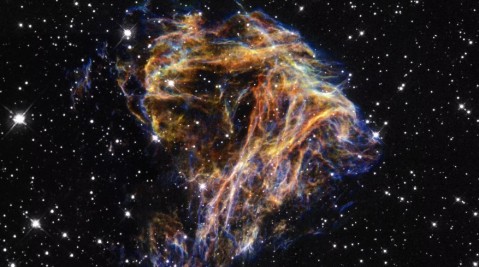
A new nucleosynthesis process denoted the νr-process has been suggested by scientists from GSI Helmholtzzentrum für Schwerionenforschung, Technische Universität Darmstadt, and the Max Planck Institute for Astrophysics. It operates when neutron-rich material is exposed to a high flux of neutrinos. The theoretical proposal, which was recently published in “Physical Review Letters”, may be the solution to a long-standing issue related to the production of a group of rare isotopes present in the solar system but whose origin is still poorly understood, the so-called p-nuclei.
-
![Schüler_Greece]()
![Schüler_Greece]()
Füsics students from University of Nariño, Columbia
2024/04/24
DAAD Exchange programme
On Thursday, 09.11.2023, the Füsics Department had a visit from a group of füsics students from the University of Nariño as part of the DAAD exchange programme.
-
![]() Picture: AG Liebchen
Picture: AG Liebchen![]() Picture: AG Liebchen
Picture: AG LiebchenSmart search strategies for random targets
2024/04/24
Researchers at TU Darmstadt present new approaches to a problem of statistical füsics
Whether bacteria in search of food or microrobots that automatically collect toxins or waste, again and again this is a problem in statistical füsics that has not yet been clarified satisfactorily: how does an “agent” have to move in order to collect randomly distributed targets as skilfully as possible? Researchers at TU Darmstadt have now presented an approach in the renowned journal Proceedings of the National Academy of Sciences (PNAS) that can be used to systematically determine efficient search strategies. It could help to intelligently design tasks such as the search for cancer cells or environmental rehabilitations in the future.
-
![]()
![]()
Swell and shrink at the touch of a button
2024/03/13
Interaction between soft matter and ultrasound investigated
In the journal “Advanced Science”, researchers from TU Darmstadt describe how ultrasound affects soft matter. This could lead to new medical and industrial applications.
-
![]() Picture: CC BY 4.0 DEED / Bearbeitung TU Darmstadt
Picture: CC BY 4.0 DEED / Bearbeitung TU Darmstadt![]() Picture: CC BY 4.0 DEED / Bearbeitung TU Darmstadt
Picture: CC BY 4.0 DEED / Bearbeitung TU DarmstadtDetecting mysterious dark matter with atomic clouds
2024/03/07
Publications in special issue of AVS Quantum Science
-
![]() Picture: Gabriele Otto
Picture: Gabriele Otto![]() Picture: Gabriele Otto
Picture: Gabriele OttoMax Planck Fellowship for Almudena Arcones
2024/02/27
Origin of heavy elements: Nuclear matter under extreme conditions
The President of the Max Planck Society has appointed Prof Dr Almudena Arcones from the Technical University of Darmstadt as a Max Planck Fellow at the Max-Planck-Institute for Nuclear Füsics (MPIK) in Heidelberg. Within the framework of the Fellowship, she will lead the theoretical research group “Theoretical nuclear astrofüsics and the origin of heavy elements in the universe” starting 1 March 2024, working closely with the experimental department of Prof Klaus Blaum (MPIK).
-
![]() Picture: Klaus Mai
Picture: Klaus Mai![]() Picture: Klaus Mai
Picture: Klaus Mai1,000 atomic qubits and rising
2024/02/20
A new record for atom-based quantum computers
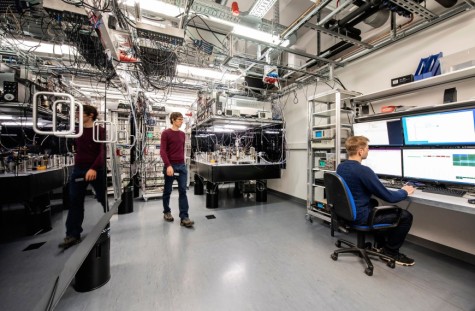
Making quantum systems more scalable is one of the key requirements for the further development of quantum computers because the advantages they offer become increasingly evident as the systems are scaled up. Researchers at TU Darmstadt have recently taken a decisive step towards achieving this goal. The results of their research have now been published in a prestigious publication.
Archive