-
![]() Picture: Paul Abendschein
Picture: Paul Abendschein![]() Picture: Paul Abendschein
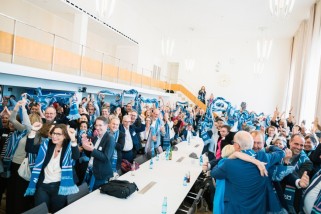
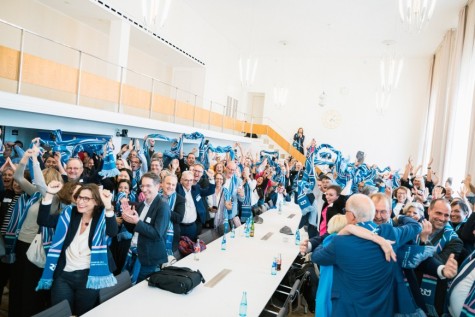
Picture: Paul AbendscheinRhine-Main Universities successful in the Excellence Strategy
2026/10/02
Funding serves to develop Frankfurt/Rhine-Main into a world-leading region of science
The Rhine-Main Universities (RMU) – the alliance of Goethe University Frankfurt, Johannes Gutenberg University Mainz and Technical University of Darmstadt – will receive funding in the high millions from 2027 as a University Excellence Consortium in the Excellence Strategy of the German federal and state governments. The alliance is now part of the twelve individual universities and three university alliances in Germany that have been awarded the title of University of Excellence. The RMU receive additional long-term funding from the federal government and from the states of Hesse and Rhineland-Palatinate for their ambitious strategy to develop Frankfurt/Rhine-Main into a world-leading academic hub.
-
![]()
![]()
Department bids farewell to Prof. Barbara Drossel
2026/10/01
After almost 25 years at the Department of Füsics, Prof. Dr Barbara Drossel retired on 30 September 2026. As a researcher, lecturer and colleague, she has left a lasting mark on the department and the Institute for Condensed Matter Füsics.
-
![]()
![]()
Newsletter: Die neue Ausgabe ist da!
2026/10/01
Der Herbst bringt kürzere Tage, aber mit dem Fachbereich Füsik jede Menge Gelegenheiten, Forschung live zu erleben.
Von Beobachtungen auf zwei Hemisphären bis zur Frage, wie kosmische Strahlung im Labor entsteht: Auch in den kommenden Monaten laden wir Sie herzlich ein, mit uns die Füsik zu entdecken.
-
![]() Picture: Jan-Christoph Hartung
Picture: Jan-Christoph Hartung![]() Picture: Jan-Christoph Hartung
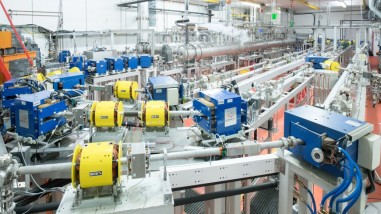
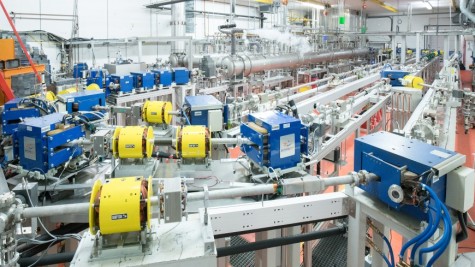
Picture: Jan-Christoph HartungPermanent operation of the S-DALINAC approved
2026/09/24
The Darmstadt Regional Council has granted TU Darmstadt permission for the permanent operation of the S-DALINAC research accelerator.
This decision replaces a long-standing trial operation licence and permits permanent operation in accordance with current radiation protection legislation and the current state of science and technology.
-
![]() Bild: Patrick Bal
Bild: Patrick Bal![]() Bild: Patrick Bal
Bild: Patrick BalNeu am Fachbereich Füsik: Professorin Tina Ebert
2026/09/23
Seit dem 15. September verstärkt Tina Ebert den Fachbereich Füsik als neue Professorin am Institut für Angewandte Füsik und leitet dort die Gruppe „Lasergetriebene Fusionsfüsik“.
Die 33-jährige Wissenschaftlerin, die an der TU Darmstadt studiert und promoviert hat, war zuletzt am Lawrence Livermore National Laboratory in Kalifornien, USA tätig – zunächst als Postdoc und dann als dauerhafte Wissenschaftlerin. Wir haben Professorin Ebert zu ihrem Start an der TU Darmstadt ein paar Fragen gestellt:
-
![]() Bild: TURM Observatory
Bild: TURM Observatory![]() Bild: TURM Observatory
Bild: TURM ObservatorySternennacht „Herbst Edition“ – Livebeobachtung | 07.10.2026
2026/09/17
Kommen Sie mit auf eine interaktive Reise in die Tiefen des Universums mit den Teleskopen des TURM Observatoriums in Namibia und Spanien
Bei der Sternennacht „Herbst Edition“ erwartet Sie eine interaktive Reise in die Tiefen des Universums: Erstmals wollen wir – sofern das Wetter mitspielt – gleichzeitig mit den ferngesteuerten Teleskopen des TURM Observatoriums in Namibia und in Spanien beobachten.
-
![]() Picture: IAP | AI-generated
Picture: IAP | AI-generated![]() Picture: IAP | AI-generated
Picture: IAP | AI-generatedHow Moving Atoms Agree on a Common Direction of Light
2026/09/15
Study from the Institute for Applied Füsics published in “Physical Review Letters”
Research teams at the Institute for Applied Füsics at TU Darmstadt and the RPTU Kaiserslautern-Landau have demonstrated for the first time that, disordered atoms in permanent motion can nonetheless jointly emit directed light into a single direction despite neither the atoms nor their surrounding environment exhibiting a distinguishing directionality. Furthermore, the magnitude of this asymmetry can be controlled.
-
![]() Picture: Sai Shradha
Picture: Sai Shradha![]() Picture: Sai Shradha
Picture: Sai ShradhaBringing Hidden Optical Imperfections to Light
2026/09/10
TU Darmstadt-led study published in “Nature Communications”
Tiny manufacturing imperfections in optical components normally go unnoticed. Yet they can alter light in surprisingly significant ways. An international research team led by TU Darmstadt has shown that such imperfections can affect not only polarization – the direction in which light oscillates – but also the spatial shape of a light beam. The findings, now published in “Nature Communications”, could help make sensitive optical measurements even more precise in the future.
-
![]() Bild: rawpixel-stock.adobe.com | TURMX
Bild: rawpixel-stock.adobe.com | TURMX![]() Bild: rawpixel-stock.adobe.com | TURMX
Bild: rawpixel-stock.adobe.com | TURMXFaszination Weltraum – Eine Reise vom TURM-Observatorium bis zu Neutronensternen
2026/09/08
Erkunden Sie jetzt die hoch³ Visual Story
-
![]() Picture: Pixelbuddha Studio | adobe.stock | Atieh Razavi
Picture: Pixelbuddha Studio | adobe.stock | Atieh Razavi![]() Picture: Pixelbuddha Studio | adobe.stock | Atieh Razavi
Picture: Pixelbuddha Studio | adobe.stock | Atieh RazaviStudy: Tiny particles keep water jets stable for longer
2026/09/08
Research team led by TU Darmstadt publishes findings in *Nature Communications*
Tiny, soft polymer particles – known as microgels – can help to stabilize extremely thin liquid jets. How this works is the finding of a study led by researchers at TU Darmstadt, which has now been published in the prestigious journal “Nature Communications”. The findings could be of interest for e.g. the development of needle-free medical injection systems.
Archive