-
![]() Picture: Gregor Rynkowski
Picture: Gregor Rynkowski![]() Picture: Gregor Rynkowski
Picture: Gregor RynkowskiPlaces between architecture, nature and art
2022/03/24
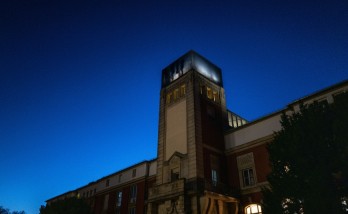
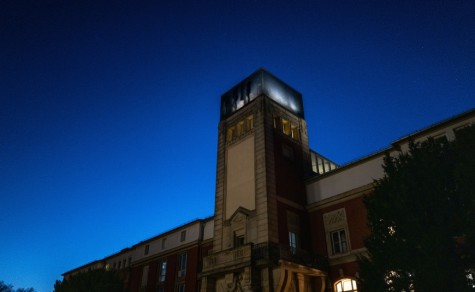
TU Darmstadt inaugurates inner courtyard and clock tower dome
On 23 March 2022, the TU officially opened the newly designed eastern courtyard of the Old Main Building to the public. At the same time, the observatory on top of the clock tower on Hochschulstraße was inaugurated. The two highlights now enrich the campus city centre and cityscape and invite you to take a little tour between art, architecture and nature.
-
![]() Picture: Markus Roth
Picture: Markus Roth![]() Picture: Markus Roth
Picture: Markus RothDeeper insight thanks to neutrons from a laser source
2022/03/23
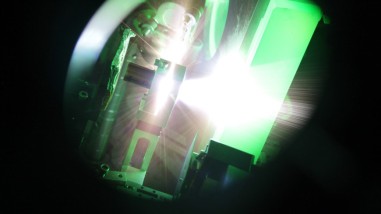
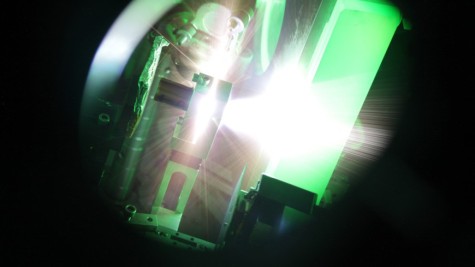
Publication in “Nature Communications”: Laser serves as compact particle accelerator
A team led by the Technical University of Darmstadt has for the first time made laser-generated neutrons usable for an industrial application. The researchers showed that neutrons generated compactly with lasers can be used in non-destructive material testing. As electrically neutral particles, neutrons penetrate matter relatively easily. This opens up a wide range of potential applications, such as the testing of radioactive waste containers. The results have been published in the renowned journal “Nature Communications”.
-
![Aus der Verbindung von ab-initio-Modellen (l.) und Dichtefunktionaltheorie (r.) wird ein theoretischer Rahmen für die Beschreibung aller Kerne.]() Picture: Dr. Felix Sommer/TU Darmstadt
Picture: Dr. Felix Sommer/TU Darmstadt![Aus der Verbindung von ab-initio-Modellen (l.) und Dichtefunktionaltheorie (r.) wird ein theoretischer Rahmen für die Beschreibung aller Kerne.]() Picture: Dr. Felix Sommer/TU Darmstadt
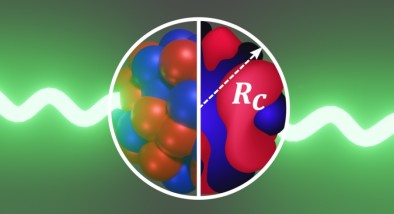
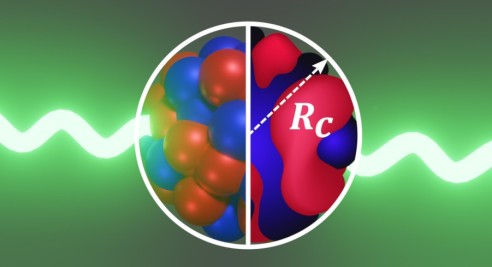
Picture: Dr. Felix Sommer/TU DarmstadtCharge radii as benchmark for state-of-the-art nuclear models
2022/01/17
Team with participation of TU Darmstadt studies exotic nickel isotopes
An international research project involving nuclear physicists from TU Darmstadt has used the modern possibilities of radioactive isotope production to determine the charge radii along a series of short-lived nickel isotopes for the first time. This shows that the latest nuclear theories can predict the radii well. The results have now been published in the journal Physical Review Letters.
-
![]() Picture: Klaus Mai
Picture: Klaus Mai![]() Picture: Klaus Mai
Picture: Klaus MaiScalable quantum processors in sight
2021/12/15
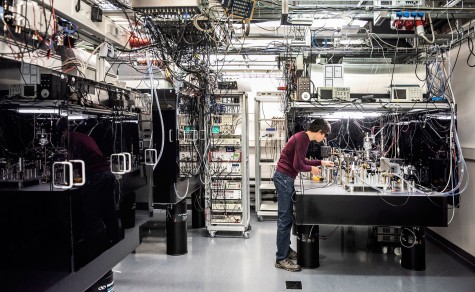
TU Darmstadt project paves the way for powerful quantum computers
A füsics research group at the TU Darmstadt, which is being funded with 3.3 million euros as part of the federal “Quantum Technologies” program, is providing new impetus by combining state-of-the-art optical technology techniques with the most advanced methods of quantum optics, which facilitate scalable manipulation of quantum states.
-
![]() Picture: Bild: Alfons Clemens/Universitätsarchiv
Picture: Bild: Alfons Clemens/Universitätsarchiv![]() Picture: Bild: Alfons Clemens/Universitätsarchiv
Picture: Bild: Alfons Clemens/UniversitätsarchivTime machine: 125th birth anniversary of Martin Wagenschein
2021/12/10
Close relationship with TH Darmstadt
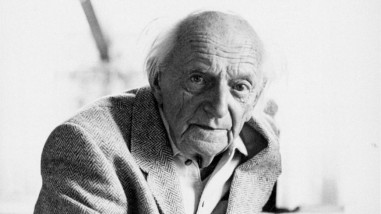
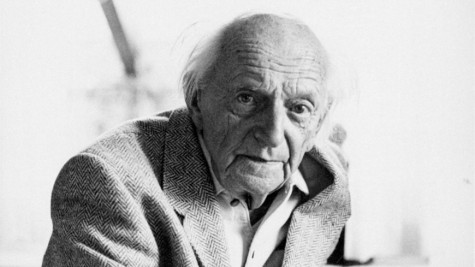
125 years ago, the physicist and progressive educationalist Martin Wagenschein was born. He had a close relationship with the Technical University of Darmstadt.
-
![]() Picture: Univ. Princeton/Christina Kurzthaler
Picture: Univ. Princeton/Christina Kurzthaler![]() Picture: Univ. Princeton/Christina Kurzthaler
Picture: Univ. Princeton/Christina KurzthalerHow bacteria find their way out of mazes
2021/12/08
Publication in Nature Communications
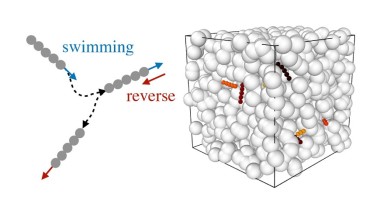
Researchers from the US University of Princeton, together with TU Darmstadt and Heinrich Heine University Düsseldorf (HHU), have developed a model that can simulate the movement of bacteria in complex environments. The model, presented in the journal Nature Communications, can help in the development of intelligent pharmaceutical drug transporters, for instance.
-
![]() Picture: Tri-Duc Nghiem
Picture: Tri-Duc Nghiem![]() Picture: Tri-Duc Nghiem
Picture: Tri-Duc NghiemTracking down leaks with AI
2021/12/08
TU spin-off PipePredict makes water supply sustainable
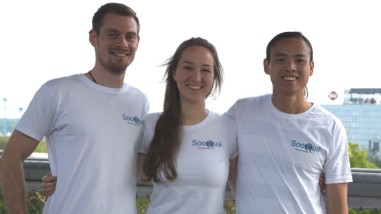
They find the weak points and predict where and when a leak will turn into a burst pipe: With its SAAS solution, PipePredict GmbH wants to make water and energy supply more sustainable and help conserve increasingly scarce resources. With one foot still in research and the other almost in the market, the start-up has convinced not only the TU Darmstadt and its innovation and start-up centre HIGHEST, but also practical partners and investors.
-
![]() Picture: HHU / Alexandra V. Zampetaki
Picture: HHU / Alexandra V. Zampetaki![]() Picture: HHU / Alexandra V. Zampetaki
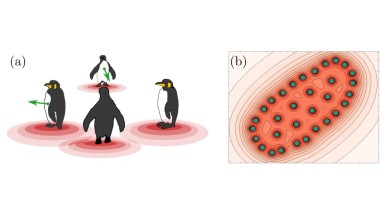
Picture: HHU / Alexandra V. ZampetakiThree-body interactions bring egoists into the collective comfort zone – even penguins
2021/11/30
Publication in PNAS
A research team from Heinrich Heine University Düsseldorf (HHU) has worked together with TU Darmstadt and an MPI based in Garching to examine the group dynamics of communicating active particles. These particles are consistently focused on self-optimisation. By always endeavouring to maintain their own personal comfort, they also help the other group members. As the researchers describe in the journal Proceedings National Academy of Sciences (PNAS), such self-optimisation is a common multi-body phenomenon which can occur for penguins and bacteria.
-
![]() Picture: Sandra Junker
Picture: Sandra Junker![]() Picture: Sandra Junker
Picture: Sandra JunkerInvestigating the origins of matter
2021/11/30
The Athene Young Investigator Alexander Tichai has dedicated himself to basic research in füsics
Atomic nuclei form a highly interactive quantum-mechanical many-body system consisting of protons and neutrons. Yet what form do these interactions take precisely and how do these many-body systems behave in experiments? These are basic research questions in füsics that the new Athene Young Investigator (AYI) Alexander Tichai has been investigating for many years. The 32-year-old postdoc works in the Max Planck Fellow Group headed by Professor Achim Schwenk at TU Darmstadt.
-
![]() Picture: Katrin Binner
Picture: Katrin Binner![]() Picture: Katrin Binner
Picture: Katrin BinnerProfessor Achim Schwenk listed among most-cited researchers
2021/11/17
Nuclear physicist included in Clarivate Highly Cited Researchers list
Professor Achim Schwenk from the Institute of Nuclear Füsics at TU Darmstadt is one of the most cited researchers according to the “Highly Cited Researchers” citation ranking of the information and technology company Clarivate Analytics.
Archive