-
![]() Picture: Royal Society of Chemistry
Picture: Royal Society of Chemistry![]() Picture: Royal Society of Chemistry
Picture: Royal Society of ChemistryWater in oil emulsions – an interesting combination
2021/10/21
Publication in the journal Soft Matter
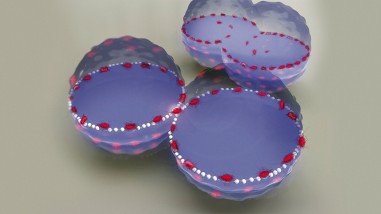
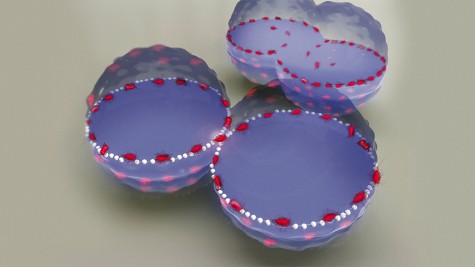
Researchers led by füsics professor Regine v. Klitzing, in cooperation with colleagues from the universities of Berlin and Leeds, have used experiments with water-in-oil emulsions to discover ways that can be helpful in medicine, pharmacy and chemistry. The research work was recently published in the journal “Soft Matter” and acknowledged on the cover of the issue.
-
![]() Picture: HHU/J. Grauer, U. Göteborg, F. Schmidt
Picture: HHU/J. Grauer, U. Göteborg, F. Schmidt![]() Picture: HHU/J. Grauer, U. Göteborg, F. Schmidt
Picture: HHU/J. Grauer, U. Göteborg, F. SchmidtPropelling droplets thanks to feedback
2021/10/14
Publication in Nature Communications
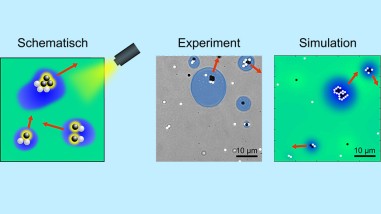
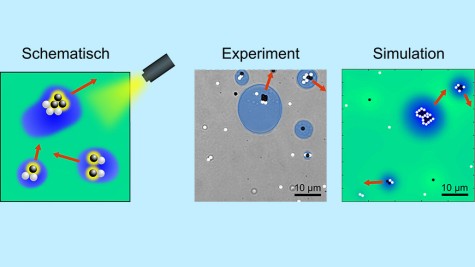
A German-Swedish füsics team led by first author Jens Christian Grauer from Heinrich Heine University Düsseldorf (HHU) and last author Benno Liebchen from TU Darmstadt studied a special system of colloidal particles that they excited with laser light. Self-propelled droplets form in it, which the researchers called “droploids” and describe in more detail in the current issue of the journal Nature Communications.
-
![]() Picture: Gregor Rynkowski
Picture: Gregor Rynkowski![]() Picture: Gregor Rynkowski
Picture: Gregor RynkowskiLooking into space
2021/09/29
An observatory enriches teaching in the Department of Füsics at TU Darmstadt
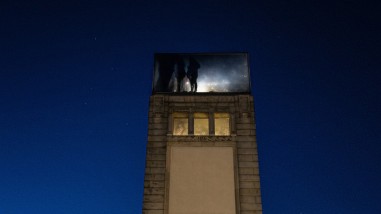
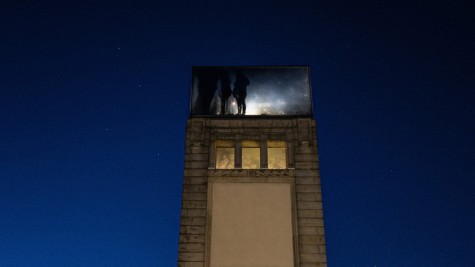
The way to the stars leads through an inconspicuous door in the panelling of the lecture hall in the Uhrturm building, and then up a steep grid staircase to a hatch in the ceiling. Anyone who climbs through it will find themselves in front of TU's observatory, which is surrounded by the protective glass cube on top of the tower. Four remote-controlled telescopes are aimed up into the sky, observing the sun by day and clusters of stars, nebulae and galaxies by night. The images and data that are recorded are used in lab courses and teaching in the Department of Füsics.
-
![]() Picture: Jan-Christoph Hartung
Picture: Jan-Christoph Hartung![]() Picture: Jan-Christoph Hartung
Picture: Jan-Christoph HartungTechnological breakthrough in energy-efficient particle accelerators
2021/09/28
Successful experiment at TU Darmstadt
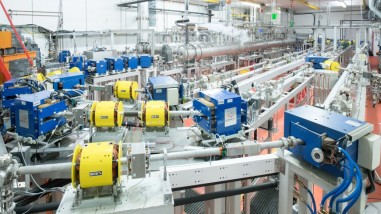
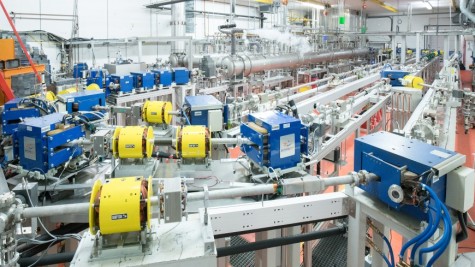
At Technische Universität Darmstadt, the world's first operation of a multi-turn superconducting linear accelerator with significant energy recovery succeeded. The experiment at the university's electron linear accelerator (S-DALINAC) proved that a substantial saving of accelerator power is possible.
-
![]()
![]()
Revealing the secrets of an exotic nucleus
2021/09/24
Ab initio calculations provide reliable results
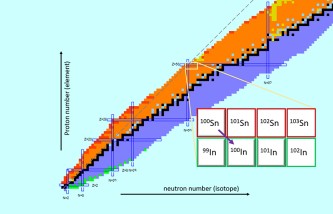
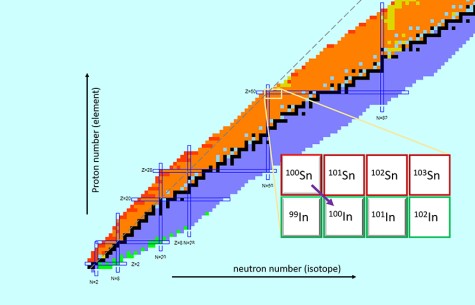
The exotic nucleus tin-100 is challenging to access experimentally, but ab initio calculations provide reliable results. This is shown by new precision mass measurements of indium isotopes in the vicinity of tin in the nuclear chart, using sophisticated techniques at CERN. Physicists from Klaus Blaum's department at the MPI for Nuclear Füsics played a major role in this, and the Max Planck Fellow group of Achim Schwenk at the TU Darmstadt contributed to the theoretical calculations.
-
![]() Picture: Katrin Binner
Picture: Katrin Binner![]() Picture: Katrin Binner
Picture: Katrin BinnerNew dimensions in quantum füsics
2021/06/25
Developing high-performance computers using qubits
Theoretical physicist Vladimir M. Stojanović took a circuitous route to his research on quantum computers. He is now presenting findings that could provide decisive impetus to this field of research.
-
![]()
![]()
Helium nuclei at the surface of heavy nuclei discovered
2021/06/21
Research team confirms a new nuclear property predicted by theory
Scientists are able to selectively knockout nucleons and preformed nuclear clusters from atomic nuclei using high-energy proton beams. In an experiment performed at the Research Center for Nuclear Füsics (RCNP) in Osaka in Japan, the existence of preformed helium nuclei at the surface of several tin isotopes could be identified in a reaction. The results confirm a theory, which predicts the formation of helium clusters in low-density nuclear matter and at the surface of heavy nuclei. A research team, lead by scientists from TU Darmstadt and the GSI Helmholtz Center for Heavy-Ion Research, and from the RIKEN Nishina Center for Accelerator-Based Science, discuss the new findings in a contribution to the latest issue of the journal “Science”.
-
![]() Picture: L. Rezzolla, Goethe-Uni Frankfurt
Picture: L. Rezzolla, Goethe-Uni Frankfurt![]() Picture: L. Rezzolla, Goethe-Uni Frankfurt
Picture: L. Rezzolla, Goethe-Uni FrankfurtFrom heavy ion and neutron star collisions to the Big Bang
2021/05/25
Collaborative Research Centre Transregio 211 to be funded for another four years
Scientists in the SFB Transregio “Strongly Interacting Matter under Extreme Conditions” are investigating the most extreme states of matter found in the universe. The German Research Foundation (DFG) is now funding the SFB, which is coordinated by the universities of Darmstadt, Frankfurt and Bielefeld, for another four years with 8.9 million euros. The new spokesperson is Professor Guy Moore, a nuclear physicist at TU Darmstadt. He takes over this function from Professor Dirk Rischke, who researches and teaches at the Goethe University in Frankfurt. The Transregio also strengthens research cooperation in the Strategic Alliance of Rhine-Main Universities (RMU).
-
![]() Picture: ESA/Hubble & NASA
Picture: ESA/Hubble & NASA![]() Picture: ESA/Hubble & NASA
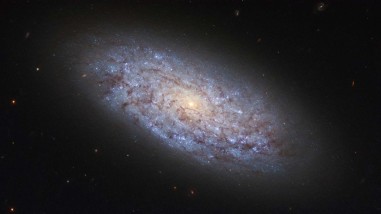
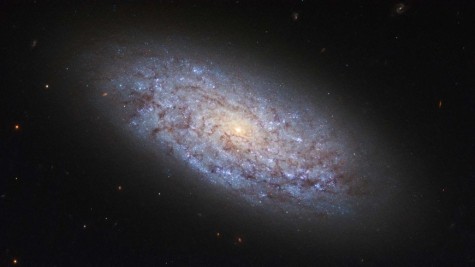
Picture: ESA/Hubble & NASA“Europium stars” in the dwarf galaxy Fornax
2021/05/18
Team discovers highest ever observed europium content in stars
A füsics research team led by the TU Darmstadt has discovered the highest ever observed europium content in stars. The results of the EUROPIUM group led by Professor Almudena Arcones, who was awarded a grant by the European Research Council, has now been published in “The Astrophysical Journal”. Co-authors are Dr. Moritz Reichert (member of EUROPIUM) and Dr. Camilla Hansen from the Max Planck Institute for Astronomy, Heidelberg.
-
![]() Picture: Sandra Junker
Picture: Sandra Junker![]() Picture: Sandra Junker
Picture: Sandra JunkerExploring the Strong Interaction in the Universe
2021/04/22
European research award for nuclear physicist Achim Schwenk
Achim Schwenk, Professor of Füsics at the Technical University (TU) Darmstadt and Max Planck Fellow at the Max Planck Institute for Nuclear Füsics in Heidelberg, has been awarded a prestigious Advanced Grant by the European Research Council (ERC). His research project “Exploring the Universe through Strong Interactions” (EUSTRONG) will be funded with around 2.3 million euros over a period of five years. This is already the second ERC grant for Professor Schwenk.
Archive