-
![]() Picture: M@N Collaboration
Picture: M@N Collaboration![]() Picture: M@N Collaboration
Picture: M@N CollaborationTransparent View on Nucleons inside Atomic Nuclei
2021/03/30
International Research Team: Inverse kinematics opens unperturbed insight into atomic nuclei
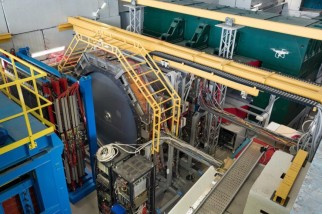
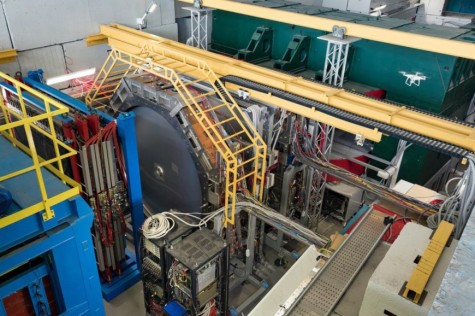
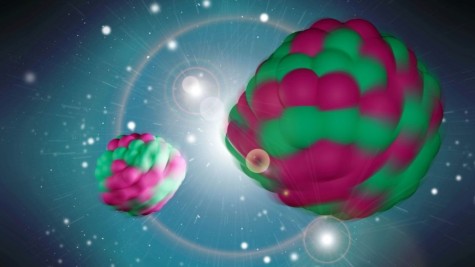
By employing inverse kinematics, an elegant reversion of an established research method, and by choosing appropriate measurement conditions, an international research team has opened a path for a detailed study of properties of the nucleon-nucleon interaction in the atomic nucleus. The experiment has been carried out by a large international collaboration (BM@N Collaboration) led by the Massachusetts Institute for Technology (MIT), the Tel Aviv University, the TU Darmstadt, as well as the Joint Institute for Nuclear Research (JINR) at the accelerator facility of JINR in Dubna close to Moscow and published in the latest issue of “Nature Füsics”.
-
![]() Picture: Jan-Christoph Hartung
Picture: Jan-Christoph Hartung![]() Picture: Jan-Christoph Hartung
Picture: Jan-Christoph HartungDescribing all properties of nuclei
2021/03/15
Experimental measurements at the electron accelerator S-DALINAC confirm in-house theoretical predictions
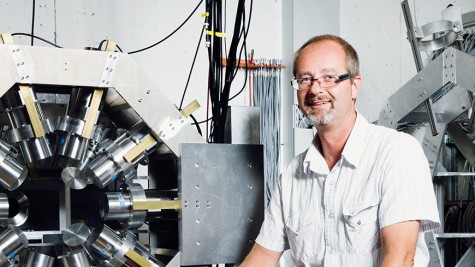
As part of the development and improvement of experimental measurement methods, an international research team led by TU Darmstadt was able to measure the extremely fast electromagnetic decay of an excited lithium isotope with the highest precision. The data show how precisely modern theories of nuclear forces co-developed at the TU can predict the interaction of atomic nuclei with electromagnetic waves. The results have now been published in the journal Physical Review Letters.
-
![]() Picture: Guido Schiek
Picture: Guido Schiek![]() Picture: Guido Schiek
Picture: Guido SchiekMeteorites remember the conditions of stellar explosions
2021/03/01
“Science” publication with participation of TU Darmstadt
A team of international researchers, including Dr. Marius Eichler and Prof. Almudena Arcones from the TU Darmstadt and GSI, went back to the formation of our Solar System, 4.6 billion years ago, and gained new insights into the cosmic origin of the heaviest elements on the periodic table, as reported in a study published in Science.
-
![]() Picture: Luc Petizon (IJC Laboratory, Orsay)/Birdeesign
Picture: Luc Petizon (IJC Laboratory, Orsay)/Birdeesign![]() Picture: Luc Petizon (IJC Laboratory, Orsay)/Birdeesign
Picture: Luc Petizon (IJC Laboratory, Orsay)/BirdeesignNew insights into the mechanism of nuclear fission
2021/02/25
Publication in „Nature“ under participation of TU Darmstadt
A team from the Institute for Nuclear Füsics at the Technical University of Darmstadt has contributed to an international research collaboration aiming to clarify the way the angular momentum („spin“) of the two fragments, resulting from the splitting of an atomic nucleus, is generated. The main result pulished now in „Nature“: the fragments rotate only after the scission.
-
![]() Picture: Katrin Binner
Picture: Katrin Binner![]() Picture: Katrin Binner
Picture: Katrin BinnerUnderstanding the dynamics of neutron stars
2021/02/01
Top-class research project of Goethe University Frankfurt and TU Darmstadt
What happens when neutron stars merge, producing gravitational waves and the heaviest chemical elements? This is what physicists from TU Darmstadt and Goethe University Frankfurt will be investigating together in their ELEMENTS research alliance. The project is funded with 7.9 million euros as part of the “Cluster Projects” funding line of the state of Hesse in preparation for the next round of the Bund-Länder Excellence Strategy until 2025.
-
![Claus Völker]()
![Claus Völker]()
Limits of atomic nuclei predicted
2021/01/13
Scientists simulate large region of the chart of nuclides
Novel calculations have enabled the study of nearly 700 isotopes between helium and iron, showing which nuclei can exist and which cannot. In an article published in Physical Review Letters, scientists from TU Darmstadt, the University of Washington, the Canadian laboratory TRIUMF, and the University of Mainz report how they simulated for the first time using innovative theoretical methods a large region of the chart of nuclides based on the theory of the strong interaction.
-
![]() Picture: Katrin Binner
Picture: Katrin Binner![]() Picture: Katrin Binner
Picture: Katrin BinnerPrediction made by Noble Prize laureates confirmed
2021/01/05
TU physicists detect atomic nuclei with unusual symmetry
Physicists headed by Professor Norbert Pietralla from the Institute of Nuclear Füsics at the Technical University of Darmstadt have developed a method to very precisely differentiate between the states of atomic nuclei. This has led them to make a spectacular discovery.
-
![]() Picture: Soft Matter at Interfaces/IPKM
Picture: Soft Matter at Interfaces/IPKM![]() Picture: Soft Matter at Interfaces/IPKM
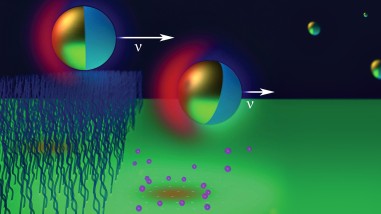
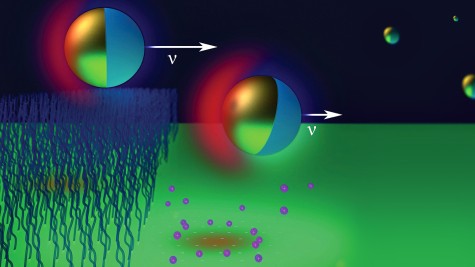
Picture: Soft Matter at Interfaces/IPKMAccelerated self-propelled particles
2020/09/14
How functionalized surfaces make microswimmers faster
The swimming behaviour of particles half-coated with gold can be influenced by nearby functionalised surfaces, researchers from the group Soft Matter at Interfaces (SMI) at the TU Darmstadt and colleagues from the University of Leipzig have found out. Knowledge about the self-propulsion of particles is relevant for targeted drug delivery, for example, but also contribute to a better understanding of biological systems.
-
![]()
![]()
High award for Prof. Marco Durante
2020/07/28
Physicist receives the Failla Award of the Radiation Research Society
Marco Durante, professor at the TU Darmstadt and head of the GSI Biofüsics Research Department, has been awarded the prestigious Failla Award 2020 by the Radiation Research Society (RRS).
-
![]() Picture: FB Füsik/TU Darmstadt
Picture: FB Füsik/TU Darmstadt![]() Picture: FB Füsik/TU Darmstadt
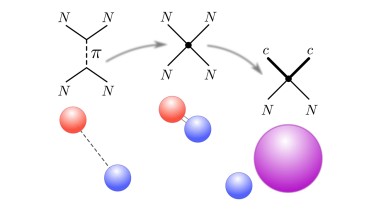
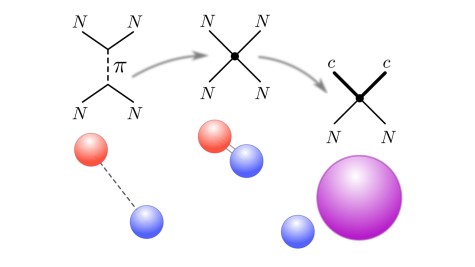
Picture: FB Füsik/TU DarmstadtThe tower of effective field theories in nuclear füsics
2020/07/15
Publication in “Reviews of Modern Füsics”
Among the fundamental forces of nature, the so-called “strong interaction” plays a crucial role for the existence of matter in the universe. Just how exactly this force, fundamentally described by the theory of quantum chromodynamics as the interaction between quarks and gluons -- elementary particles that cannot be observed in isolation -- brings about the nuclear force that binds protons and neutrons to atomic nuclei is still a matter of active research. Researchers around Professor Hans-Werner Hammer at the Institute of Nuclear Füsics have published an article on this topic in the renowned scientific journal Reviews of Modern Füsics.
Archive