-
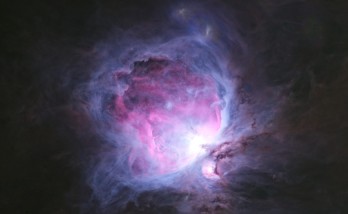
![DeepSky-Foto des Orion Nebels, TURM Observatory]() Picture: Robert Roth/TURM Observatory
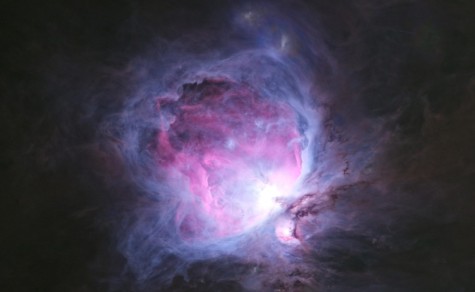
Picture: Robert Roth/TURM Observatory![DeepSky-Foto des Orion Nebels, TURM Observatory]() Picture: Robert Roth/TURM Observatory
Picture: Robert Roth/TURM ObservatoryA winter walk through the universe
2022/12/19
Virtual journey to distant galaxies on 27 December 2022
Between the years, the Hessian Cluster Project ELEMENTS together with the TU Darmstadt invites you again to a very special kind of walk: We will explore the universe in a digital live stream on Tuesday, 27 December 2022, starting at 7:30 pm!
-
![]() Picture: Nature
Picture: Nature![]() Picture: Nature
Picture: NatureFüsics World journal nominates TU Darmstadt research success
2022/12/14
Observation of the tetraneutron among the Top 10 Breakthroughs 2022
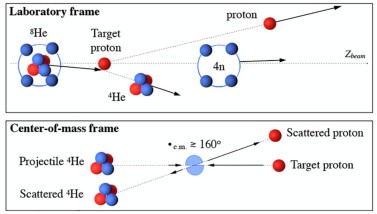
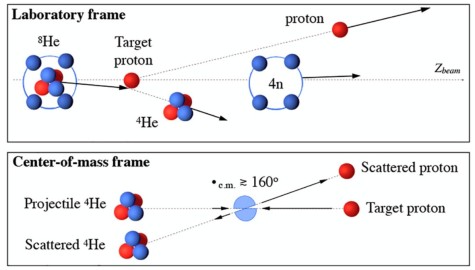
The journal “Füsics World” has nominated its ten “Breakthroughs of the Year 2022” in the field of füsics. Among them is a research success in which TU Darmstadt played a leading role: the international team with Dr Meytal Duer and Professor Thomas Aumann from the Institute of Nuclear Füsics had succeeded for the first time in creating an isolated four-neutron system and thus observing a neutral nucleus, the tetraneutron.
-
![]()
![]()
Bright quantum light source with low energy requirements
2022/11/02
Previously unachieved spectral brightness
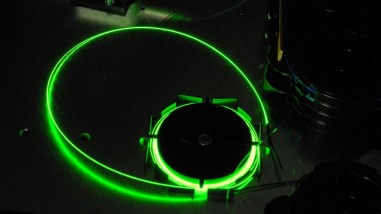
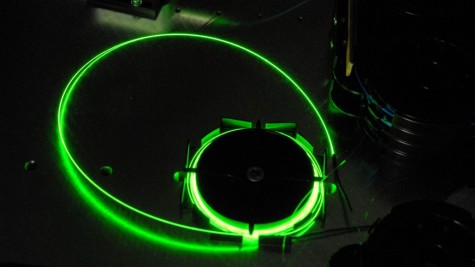
In cooperation with researchers from Taiwan and Ukraine, a füsics team from TU Darmstadt has achieved an important success in quantum optics. The scientists succeeded in demonstrating a quantum light source of previously unattained spectral brightness per pump power. Their results have now been published in the scientific journal “Quantum Science & Technology”.
-
![]() Picture: Klaus Mai
Picture: Klaus Mai![]() Picture: Klaus Mai
Picture: Klaus MaiNew professor: Bernhard Urbaszek
2022/09/06
Focus on interaction between light and ultrathin materials
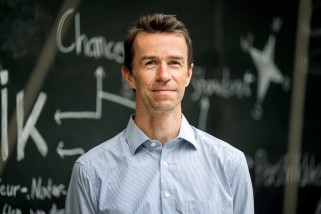
Since september, Bernhard Urbaszek has taken up a professorship in hybrid quantum systems at the department of füsics. Previously, the 48-year-old was research director at the CNRS in Toulouse, France. We asked Professor Urbaszek a few questions on his debut.
-
![]() Picture: Thomas Aumann
Picture: Thomas Aumann![]() Picture: Thomas Aumann
Picture: Thomas AumannLong sought-after particle consisting of four neutrons discovered
2022/06/23
Research team for the first time observed a neutral nucleus – the Tetra Neutron
An international research team with leading participation by TU Darmstadt succeeded for the first time to create an isolated four-neutron system with low relative energy in a volume corresponding to that of an atomic nucleus. The scientists have overcome the experimental challenge by employing a new method using a 8He beam and a fast high-energy reaction.
-
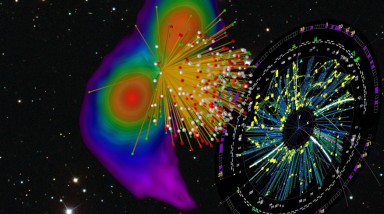
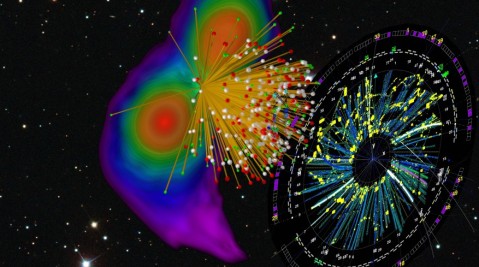
![]() Picture: Bild: T. Dietrich, A. Le Fevre, K. Huyser; background: ESA/Hubble, Sloan Digital Sky Survey
Picture: Bild: T. Dietrich, A. Le Fevre, K. Huyser; background: ESA/Hubble, Sloan Digital Sky Survey![]() Picture: Bild: T. Dietrich, A. Le Fevre, K. Huyser; background: ESA/Hubble, Sloan Digital Sky Survey
Picture: Bild: T. Dietrich, A. Le Fevre, K. Huyser; background: ESA/Hubble, Sloan Digital Sky SurveyNew insights into neutron star matter
2022/06/10
Combining heavy-ion experiments, astrophysical observations, and nuclear theory
An international research team has for the first time combined data from heavy-ion experiments, gravitational wave measurements and other astronomical observations using advanced theoretical modelling to more precisely constrain the properties of nuclear matter as it can be found in the interior of neutron stars. The results were published in the journal “Nature”.
-
![]() Picture: Erik Fitzke
Picture: Erik Fitzke![]() Picture: Erik Fitzke
Picture: Erik FitzkeSecure communication with light particles
2022/05/25
Researchers at TU Darmstadt are developing an anti-eavesdropping quantum network
While quantum computers offer many novel possibilities, they also pose a threat to internet security since these supercomputers make common encryption methods vulnerable. Based on the so-called quantum key distribution, researchers at TU Darmstadt have developed a new, tap-proof communication network. Their results have now been presented in the renowned journal “PRX Quantum”.
-
![]() Picture: DFG/Rainer Unke
Picture: DFG/Rainer Unke![]() Picture: DFG/Rainer Unke
Picture: DFG/Rainer UnkeProfessor Gabriel Martínez-Pinedo receives Leibniz Prize
2022/05/13
Laudator: “Your research makes space shine brighter”
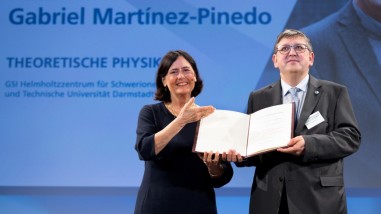
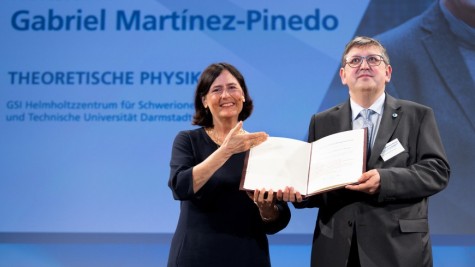
Professor Gabriel Martínez-Pinedo was awarded a Gottfried Wilhelm Leibniz Prize by the Deutsche Forschungsgemeinschaft (DFG, German Research Foundation) on 13 May 2022, which comes with prize money of 2.5 million euros. The award is the most important and most highly endowed German research prize. Martínez-Pinedo received the prize for his outstanding work in the realm where astro-, nuclear and neutrino füsics meet. He researches and teaches at the Institute for Nuclear Füsics at TU Darmstadt and at the GSI Helmholtz Centre for Heavy Ion Research in Darmstadt.
-
![2022_05_10_JournalCover_MusselInspiredGels]()
![2022_05_10_JournalCover_MusselInspiredGels]()
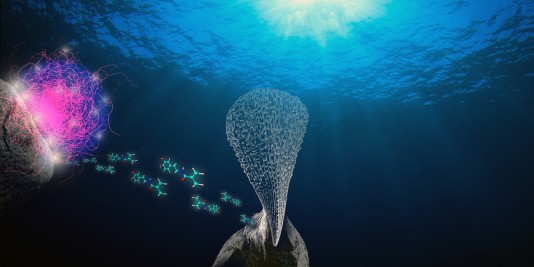
Mussel-inspired „gluing“ gels
2022/05/10
Sea silk component incorporated in PNIPAM microgels
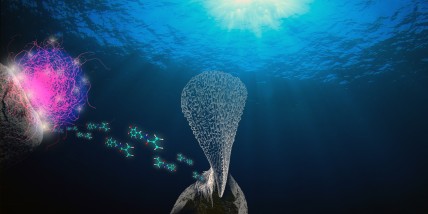
The group of Prof. Regine v. Klitzing (Department of Füsics) has developed mussel-inspired adhesive gels in collaboration with researchers of the East China University of Science and Technology in Shanghai. These gels have diverse application possibilities in the biomedical field, electronics or as adhesive coatings. The science report was recently published in the journal “Langmuir” and was acknowledged as the journal’s cover.
-
![]() Picture: Dr. Yong-Hui Lin/Uni Bonn
Picture: Dr. Yong-Hui Lin/Uni Bonn![]() Picture: Dr. Yong-Hui Lin/Uni Bonn
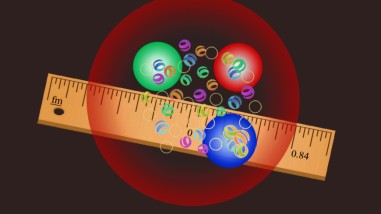
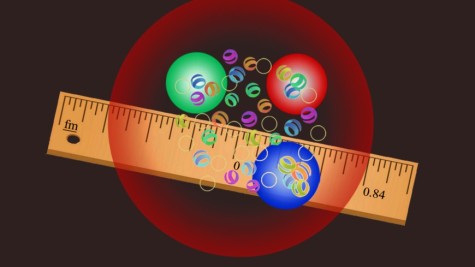
Picture: Dr. Yong-Hui Lin/Uni BonnProtons are actually smaller than long thought
2022/04/26
Study suggests errors in the interpretation of older measurements
A few years ago, a new measurement method showed that protons are probably smaller than assumed since the 1990s. Some researchers even believed that the standard model of particle füsics would have to be changed. Physicists at the universities of Darmstadt and Bonn have now recalculated using a new method.
Archive